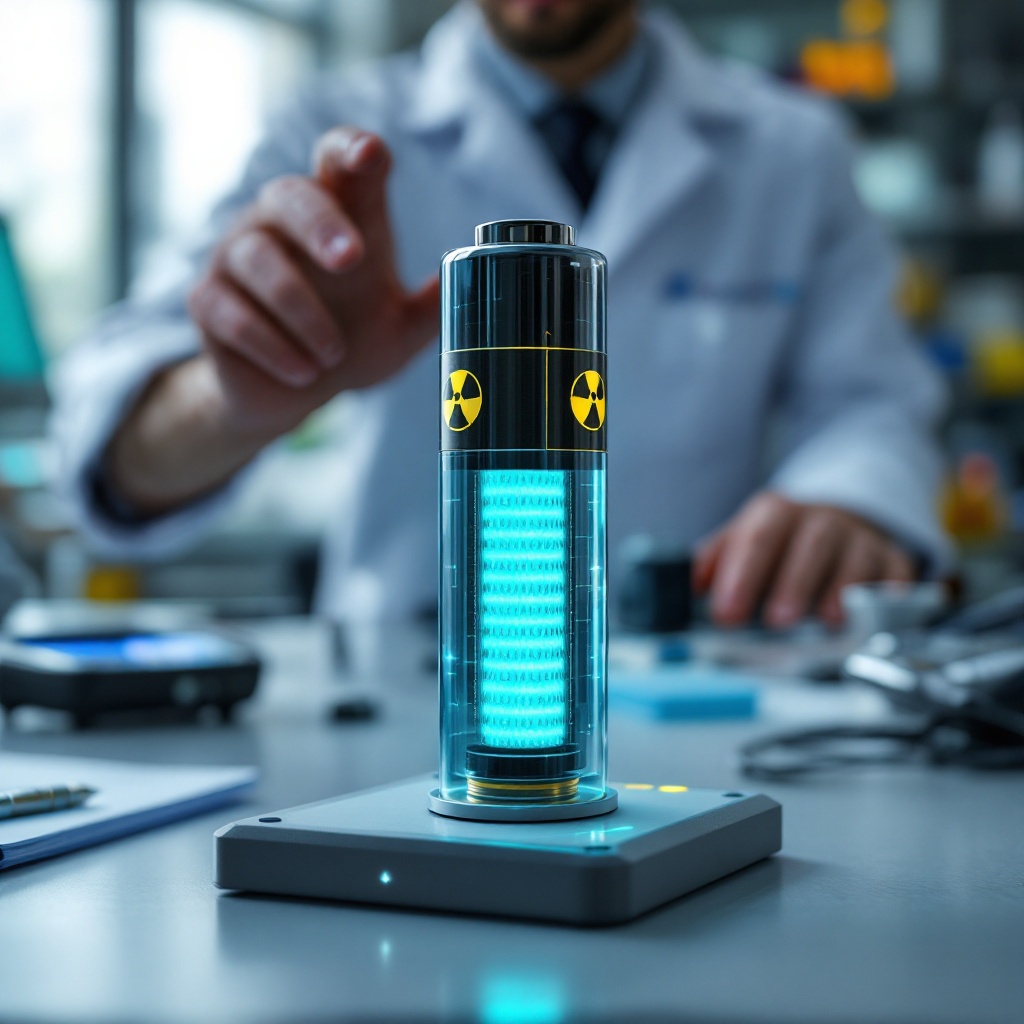
DARPA Backs Seven Teams in Race to Build a Nuclear Battery That Lasts 30 Years
DARPA has funded seven competing teams under its Rads to Watts program to develop a new class of miniature nuclear power cell built on radiovoltaics, technology that could run devices from satellites to tactical radios to pacemakers for years or decades without recharging. The objective is a compact power source tough enough to work in environments that freeze or fry conventional systems. The effort targets what DARPA program manager Tabitha Dodson identifies as the central obstacle to transpor
OST Staff · July 29, 2026
DARPA has funded seven competing teams under its Rads to Watts program to develop a new class of miniature nuclear power cell built on radiovoltaics, technology that could run devices from satellites to tactical radios to pacemakers for years or decades without recharging. The objective is a compact power source tough enough to work in environments that freeze or fry conventional systems.
The effort targets what DARPA program manager Tabitha Dodson identifies as the central obstacle to transportable nuclear power: heat and weight. Fission reactors and radioisotope thermal generators contain enormous energy, but they require heavy, non-transportable hardware to manage the heat they produce. That heat management piece, Dodson said, is always what drags down the dreams of transportable nuclear power.
Radiovoltaics bypass that problem by turning radiation directly into electricity rather than converting it into heat first. The cells capture radioactive particles in a semiconductor, which excites electrons into a usable current, the same principle by which photovoltaic solar panels capture photons. The difficulty is that intense energies can damage electronic systems over long exposure. As City Labs co-founder and CEO Pete Cabuay put it, if a particle has too much energy, it will destroy the semiconductor.
The seven teams span a range of approaches. City Labs is using tritium, which emits a milder form of beta particle, and is packing more tritium into a smaller volume to reach the required output. Cabuay said the company is sticking with tritium because the US patent database is littered with failed radiovoltaic ideas that burned out on higher-energy sources. Project Omega founder and CEO Staff Sheehan framed the ambition plainly, saying the goal is to replace the AA battery with something that lasts 30 years, with larger versions capable of replacing diesel generators at forward bases and the smallest fitting on a computer chip.
Other teams are pursuing higher-energy radiation. BWXT, teamed with the Johns Hopkins University Applied Physics Laboratory, is using alpha particles and searching for semiconductor materials that can withstand intense radiation. Justin Kasper, chief of technologies at BWXT, said the team wants to hammer the material all the time to generate meaningful power, and uses AI to simulate billions of possible crystal structures. Avalanche Energy is also using alpha particles but protects its semiconductor with an absorbing layer of liquid metal, lead physicist Daniel Velazquez explained, converting the alphas into more manageable electrons before the semiconductor turns them into power. A team led by Morgan State University in Maryland, partnered with Project Omega, uses higher-energy beta particles from strontium-90, with Northrop Grumman providing AI simulations of candidate materials.
All the competing radiovoltaics have already demonstrated power outputs of at least 10 watts per kilogram, Dodson said, two to three times as efficient as traditional RTGs. She said she is confident the teams could reach somewhere between 10 and 100 watts per kilogram. The program aims to produce a power source roughly the size of a AA battery. The source does not specify a timeline or funding level for the effort.
The teams will finalize their prototype power cells over 15 months, into next year, Dodson said. The best designs then proceed to a nine-month endurance test to see whether they hold up under their own internal radiation and external environmental pressures. After that, the aim is to have at least one candidate ready to transition to large-scale deployment with the military.