Cowboy Space Leases 291,000-Square-Foot Kent Plant to Build Orbital Data Center Satellites
California-based Cowboy Space is leasing a 291,035-square-foot industrial facility in Kent, Wash., to support production of hardware for its planned constellation of AI data center satellites. The transaction is the largest industrial lease in the Puget Sound region so far this year, marking a step from concept toward hardware for the company's orbital compute ambitions. The facility at 7650 S. 228th St. previously served as a Costco distribution and delivery center. Newmark, the real estate br
OST Staff · September 6, 2026
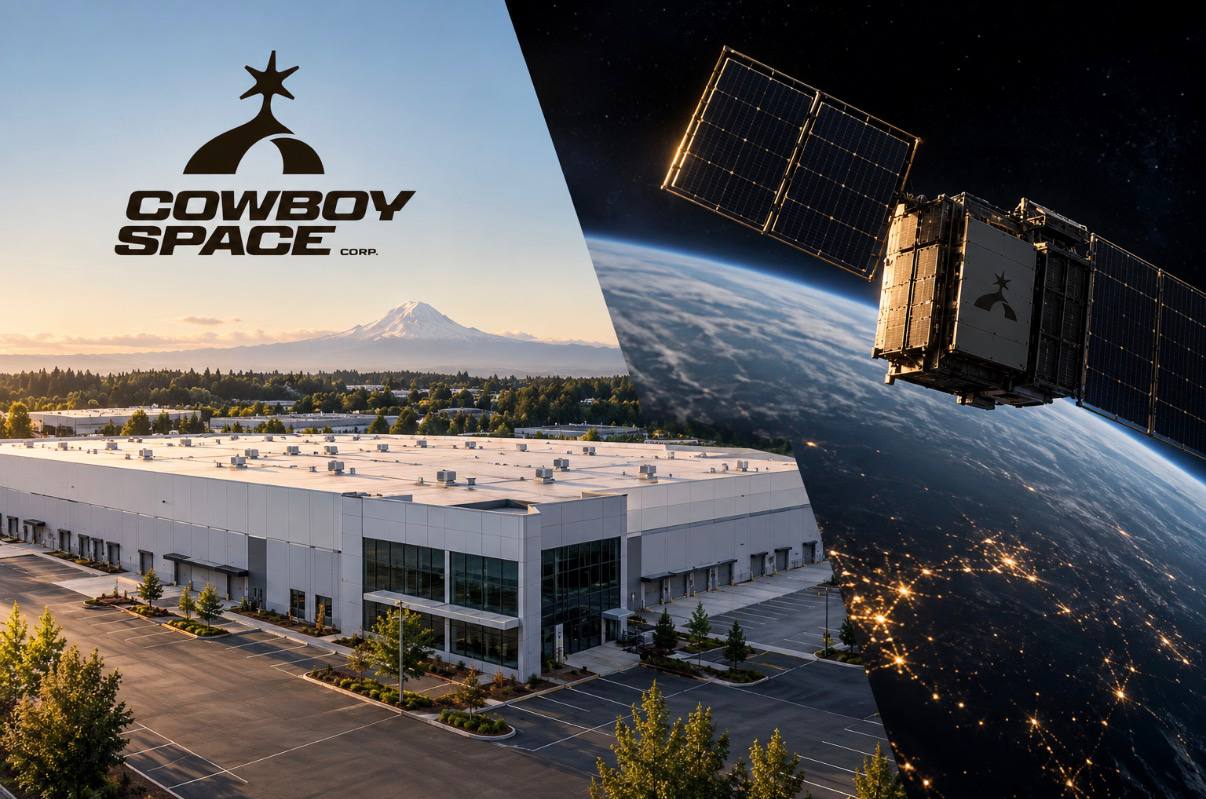
California-based Cowboy Space is leasing a 291,035-square-foot industrial facility in Kent, Wash., to support production of hardware for its planned constellation of AI data center satellites. The transaction is the largest industrial lease in the Puget Sound region so far this year, marking a step from concept toward hardware for the company's orbital compute ambitions.
The facility at 7650 S. 228th St. previously served as a Costco distribution and delivery center. Newmark, the real estate broker for the deal, represented CenterPoint Properties, Cowboy Space's new landlord. Cowboy Space plans to convert the building into a manufacturing operation supporting space and rocket development, expected to add 300 jobs. The company is currently listing 46 Kent-based positions in its careers database.
"This building was originally designed for large-scale logistics users, but Cowboy Space recognized the opportunity to reimagine it as a highly specialized production facility," said Taylor Hoff, a vice chairman at Newmark's office in Bellevue, Wash. Kent, about 20 miles south of Seattle, is a hotspot for space companies in the Pacific Northwest, hosting Boeing's Kent Space Center, Jeff Bezos' Blue Origin and Stoke Space.
Cowboy Space, previously known as Aetherflux, plans to send its own rockets into low Earth orbit as early as 2028, with the upper stages outfitted to serve as solar-powered orbital data centers. The Stampede constellation is aimed at getting around the land, power and water constraints that have made ground-based AI data centers increasingly controversial. "We are building what I call the last big clean-sheet launch vehicle in my lifetime, so it's going to be a very big heavy-lift vehicle, and we're working every day to bring it to reality," said Warren Lamont, Cowboy Space's head of launch and propulsion, in a LinkedIn video. Lamont, who previously worked for IonQ and Blue Origin, is one of the executives heading up the company's engineering hub in the Seattle area.
The company announced in May that it raised $275 million in a Series B funding round, in part to expand its production capability. Cowboy Space is collaborating with Nvidia to deploy the chip company's Nvidia Space-1 Vera Rubin Modules in orbit. In July, it secured a deal to test its propulsion system at NASA's Stennis Space Center in Mississippi. "We're really excited to get into first engine hot-fire next year," Lamont said.
The lease signals a scale-up of manufacturing for a company moving from concept toward building physical hardware. Space-based data centers are pitched as a way to run compute in orbit using abundant solar power, and a large dedicated factory lease is a concrete indication that Cowboy Space is advancing toward production.
Cowboy Space's potential competitors include SpaceX, which wants to launch up to a million AI-processing satellites, and Redmond, Wash.-based Starcloud, which is setting up a production facility in Woodinville, Wash., and seeking authorization for up to 88,000 data center satellites.
Cowboy Space aims to begin launching rockets into low Earth orbit as early as 2028, with a first engine hot-fire planned for next year. The company did not immediately respond to requests for comment.