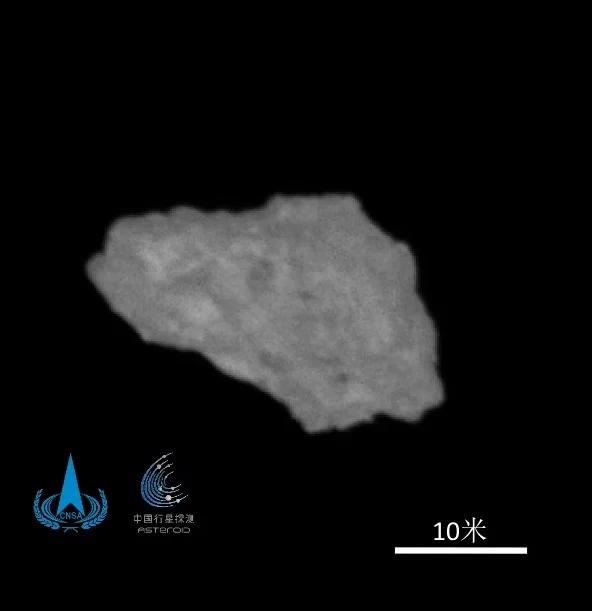
Tianwen-2 Delivers First Close View of Kamoʻoalewa After 400-Day Chase
China's Tianwen-2 spacecraft has returned the first close-up image of the near-Earth asteroid Kamoʻoalewa, photographing the object from about 20 kilometres away on 2 July 2026 after a 400-day heliocentric transfer covering roughly one billion kilometres. The China National Space Administration released the image on 6 July, showing an elongated grey body against black space with a 10-metre scale bar. It was the first close view of an object that telescopes had previously recorded as little more
OST Staff · August 26, 2026
China's Tianwen-2 spacecraft has returned the first close-up image of the near-Earth asteroid Kamoʻoalewa, photographing the object from about 20 kilometres away on 2 July 2026 after a 400-day heliocentric transfer covering roughly one billion kilometres. The China National Space Administration released the image on 6 July, showing an elongated grey body against black space with a 10-metre scale bar. It was the first close view of an object that telescopes had previously recorded as little more than a moving point of light.
The one billion kilometres describes the flight path, not a separation. Kamoʻoalewa follows a solar orbit similar to Earth's, but Tianwen-2 still had to reshape its own trajectory and arrive with a low enough relative speed to travel alongside a target that may be only 20 metres wide. The image arrives at a scientifically awkward moment, as new telescope data, laboratory experiments and population models have reopened the long-standing possibility that the asteroid is a fragment of the Moon.
Tianwen-2 launched on 29 May 2025 aboard a Long March 3B. CNSA says the probe made deep-space and mid-course corrections before first detecting the asteroid on 6 June 2026. On 7 June, from about 30,000 kilometres away, it performed capture control and entered coplanar flight. By 19 June it was 2,000 kilometres away. Before arrival, Kamoʻoalewa's position carried an uncertainty of hundreds of kilometres derived from faint ground-based observations. Optical navigation during the approach reduced that error to the kilometre scale.
The object's small size raises the difficulty of the sampling problem. Surface gravity is extremely weak, so the spacecraft cannot settle into an ordinary circular orbit. A 27.9-minute rotation, confirmed independently by the James Webb Space Telescope, moves surface features quickly beneath the probe, and a sampling site selected from one viewing angle soon rotates out of sight. CNSA describes the close phase as gradual exploration while flying, using hovering and active arcs to build shape, composition and internal-structure maps. Tianwen-2 carries 11 scientific instruments, including colour and multispectral cameras, visible-infrared and thermal spectrometers, radar, a magnetometer, particle analysers and navigation sensors.
The lunar-origin hypothesis had rested on two indirect lines of evidence. A 2021 reflectance study found a very red spectral slope and a silicate absorption feature that matched space-weathered lunar material. A 2024 Nature Astronomy study proposed the 22-kilometre Giordano Bruno crater on the lunar far side as a possible source. New work has put pressure on both. Webb's February 2026 spectrum was notably less red between 1 and 2.5 micrometres than the earlier ground result, and Large Binocular Telescope measurements from April agreed with Webb. A June preprint led by Benjamin Sharkey found colours resembling S-, V- or E-type silicate asteroids more closely than strongly reddened lunar material, and estimated a mean diameter of 18 plus or minus 2 metres.
The first image proves something specific: the navigation system found the target and the spacecraft could approach to 20 kilometres. It does not yet reveal whether Kamoʻoalewa is one coherent rock, a fractured aggregate or a rubble pile held together by its own faint gravity.
Tianwen-2 will eventually return a sample from Kamoʻoalewa to Earth. The Sharkey team's paper remains a preprint and should not be treated as a final classification, leaving the close-phase mapping and the sample itself to resolve the object's true nature.