China Sends TJS-27 Pair Into New Orbit, Orbits First Third-Generation Tianlian Relay
China launched a pair of classified satellites, TJS-27A and TJS-27B, into an orbital regime not previously used by the series, while separately orbiting the first of a new generation of data relay satellites. The two missions, hours apart on July 29, marked China's 52nd and 53rd launches of 2026, putting the country on course to exceed 100 launches in a single calendar year for the first time. A Long March 6A lifted off at 9:00 p.m. Eastern July 29 from Taiyuan Satellite Launch Center. The Chin
OST Staff · August 1, 2026
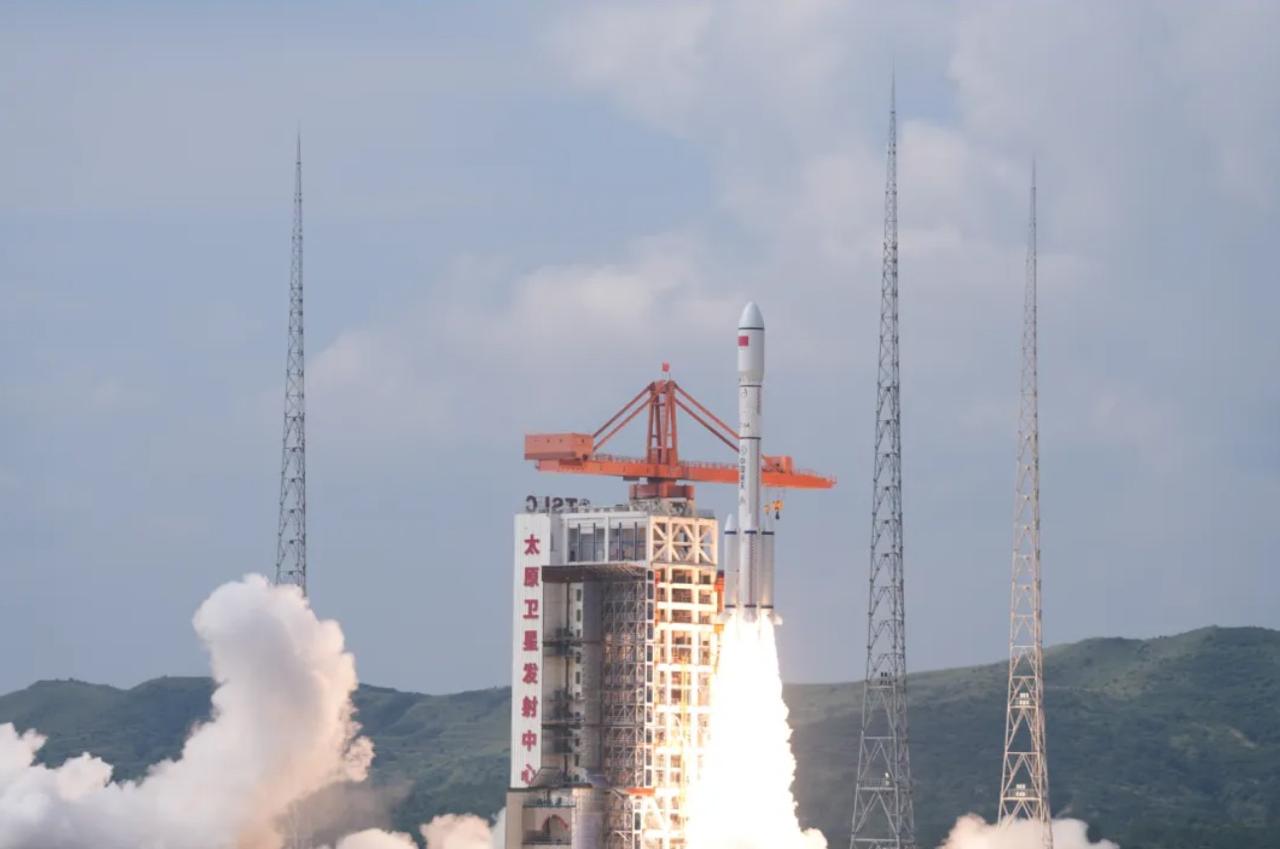
China launched a pair of classified satellites, TJS-27A and TJS-27B, into an orbital regime not previously used by the series, while separately orbiting the first of a new generation of data relay satellites. The two missions, hours apart on July 29, marked China's 52nd and 53rd launches of 2026, putting the country on course to exceed 100 launches in a single calendar year for the first time.
A Long March 6A lifted off at 9:00 p.m. Eastern July 29 from Taiyuan Satellite Launch Center. The China Aerospace Science and Technology Corporation announced launch success and identified the payloads as communication technology test satellites 27A and 27B. Hours earlier, a Long March 7A lifted from Wenchang Satellite Launch Center at 7:50 a.m. Eastern, carrying Tianlian-3 (01) toward geosynchronous transfer orbit.
CASC stated the TJS-27 satellites are mainly for satellite communication, broadcasting and television, data transmission and other services, and to carry out related technology experiments and verifications, providing no further details. The China Academy of Space Technology developed TJS-27A, while the Shanghai Academy of Spaceflight Technology developed TJS-27B. The U.S. Space Force tracked the pair in 1,153-kilometer altitude orbits with an inclination of 64.8 degrees.
Space activity tracker Jonathan McDowell noted the orbits are characteristic of time-delay-of-arrival electronic intelligence satellites, with the U.S. equivalent being the classified Naval Ocean Surveillance System. "China's earlier missions in this orbit were given a Yaogan rather than TJS cover name," McDowell noted. Such satellites are thought primarily to be for electronic intelligence and signals intelligence gathering, and Yaogan and NOSS satellites are typically launched as triplets in triangular formations. It is unclear whether TJS-27A and B will operate as a pair or form the beginning of a partial constellation.
TJS spacecraft are classified satellites that, until this mission, have largely been deployed in geosynchronous orbits, with TJS-13 and TJS-21 sent to Molniya orbits. TJS-3, launched in 2018, released an object that carried out subsequent maneuvers, indicating a subsatellite capable of coordinated movements, and the main satellite later made close approaches to U.S. satellites. Western analysts see the series as carrying out signals intelligence, early warning and satellite inspection activities to support the People's Liberation Army.
Tianlian-3 (01), developed by CAST, is part of a geostationary program providing communications relay and tracking and control support for crewed spacecraft, the Tiangong space station and other missions. It is similar in function to the U.S. Tracking and Data Relay Satellite System. The third-generation satellites are based on the DFH-4E enhanced bus, whereas the second generation used the standard DFH-4. CAST stated the satellites are equipped with a new generation of payload products and that multi-user parallel data transmission capability has been greatly enhanced. The launch followed less than a week after Tianlian-2 (06), whose Long March 3B was struck by lightning on ascent.
The apparent addition of a new mission type to the TJS series, alongside the relay network upgrade, points to an expansion of China's on-orbit capabilities. The Long March 7A flight also marked the 50th successful mission from Wenchang, which opened in 2016.
Wenchang will host the Chang'e-7 lunar south pole landing mission later in August. Facilities for the Long March 9 and Long March 10 rockets, designed for large space infrastructure and crewed lunar missions, are under construction at the spaceport.