LandSpace Lands Zhuque-3 First Stage in China's First Ground-Pad Booster Recovery
LandSpace successfully soft-landed the first stage of its Zhuque-3 rocket on a downrange pad on August 18 after delivering a payload to orbit, marking China's first recovery of an orbital-class booster on landing legs. The feat came on only the second flight of the methalox vehicle and places Zhuque-3 among just four flight-proven, partially reusable orbital-class rockets worldwide. The mission built directly on Zhuque-3's December 2025 maiden flight, which delivered a dummy payload to low Eart
OST Staff · August 19, 2026
LandSpace successfully soft-landed the first stage of its Zhuque-3 rocket on a downrange pad on August 18 after delivering a payload to orbit, marking China's first recovery of an orbital-class booster on landing legs. The feat came on only the second flight of the methalox vehicle and places Zhuque-3 among just four flight-proven, partially reusable orbital-class rockets worldwide.
The mission built directly on Zhuque-3's December 2025 maiden flight, which delivered a dummy payload to low Earth orbit but ended with the booster impacting the ground at high speed next to its landing pad following an abnormal landing burn. Had that first attempt succeeded, Zhuque-3 would have become the first non-American orbital-class booster to land back on Earth. That title instead went to the Chang Zheng 10B, built by the China Academy of Launch Vehicle Technology, whose kerolox booster was caught at sea last month.
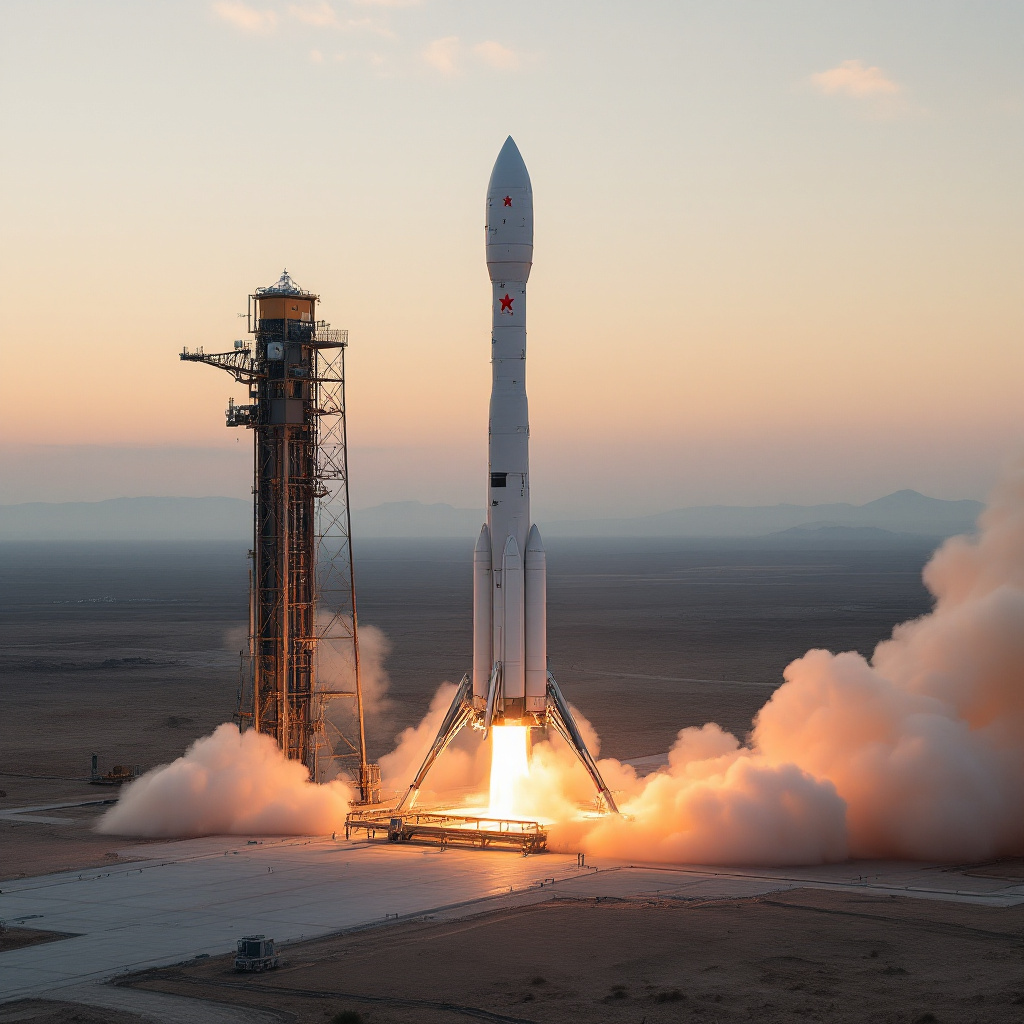
Zhuque-3 lifted off from the Jiuquan Satellite Launch Center at 23:35 UTC on August 18, roughly a third into a 37-minute window and about one hour after sunrise. The 66-meter vehicle, with a 4.5-meter diameter, used its nine Tianque-12A first-stage engines producing 7,200 kilonewtons of thrust to pitch downrange. Clear skies allowed ground observers to track the vehicle through Max Q. The ascent produced the characteristic purple, magenta, and orange exhaust hues of methane and oxygen combustion, with insulation shedding as planned.
After stage separation and re-entry, the booster touched down nearly at the center of a pad roughly 390 kilometers downrange, on a single Tianque-12 engine with all four landing legs deployed, an improvement in accuracy over the first flight. Because the Jiuquan Satellite Launch Center sits roughly 1,500 kilometers inland, the profile is not a return-to-launch-site landing, but the downrange arrangement provides payload-mass benefits without the corrosion risks of seawater recovery. China's state-run CCTV confirmed the second stage reached orbit. The exact nature of the payload remains undisclosed, and further details are expected later. In the current configuration, Zhuque-3 is limited to eight tonnes to LEO with downrange recovery.
The achievement adds LandSpace to a small group of entities that have demonstrated partial reusability of orbital-class boosters. For a decade that capability belonged solely to SpaceX. The number of flight-proven, orbital-class, partially reusable launch vehicles now stands at four: Falcon 9, which first landed a decade ago, New Glenn, which first landed in November 2025, Chang Zheng 10B, and Zhuque-3. With its second flight, LandSpace has demonstrated both orbital delivery and first-stage recovery.
LandSpace is developing a block upgrade, the Zhuque-3E, introducing Tianque-12B and Tianque-15B engines on the first and second stages, raising vehicle height from 65.9 to 76.2 meters and lift-off mass by roughly 100 metric tonnes. These changes are expected to raise downrange-recovery performance to 18.3 tonnes to LEO, closer to Falcon 9's advertised 17.5 tonnes. Zhuque-3 is also reportedly under contract to launch the Haolong cargo spacecraft, a spaceplane designed to deliver and return cargo from the Tiangong Space Station, intended as a lower-cost alternative to the expendable Tianzhou vehicle. Additional Chinese vehicles under development, including the Chang Zheng 12A and Space Pioneer's Tianlong-3, are expected to pursue similar recovery capability.