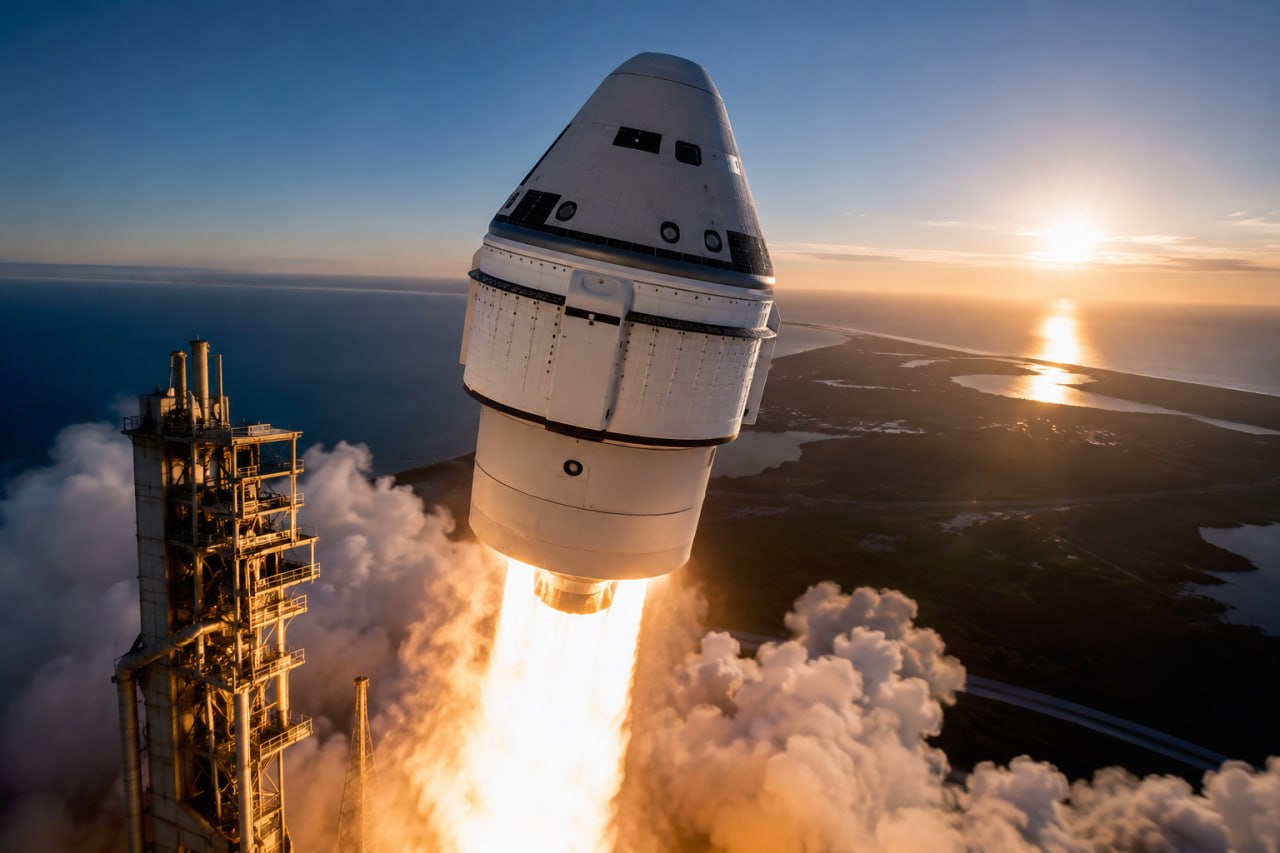
Boeing Says Starliner Redesign Progressing, Cargo Flight Possible This Year
Boeing Chief Executive Officer Kelly Ortberg said the redesign of Starliner's deficiencies is "going quite well," raising the prospect that the troubled spacecraft could return to flight before the end of 2026. The comments mark the most optimistic public signal on the program since NASA classified Starliner's 2024 crewed test as a serious failure. In February, NASA formally designated the 2024 crewed flight a "Type A" mishap, an acknowledgement of a serious failure. NASA Administrator Jared Is
OST Staff · July 29, 2026
Boeing Chief Executive Officer Kelly Ortberg said the redesign of Starliner's deficiencies is "going quite well," raising the prospect that the troubled spacecraft could return to flight before the end of 2026. The comments mark the most optimistic public signal on the program since NASA classified Starliner's 2024 crewed test as a serious failure.
In February, NASA formally designated the 2024 crewed flight a "Type A" mishap, an acknowledgement of a serious failure. NASA Administrator Jared Isaacman said the agency was working with Boeing to fully understand and remediate the risks associated with the spacecraft, and stated that Starliner would not fly its next mission, a cargo flight to the International Space Station, until those problems were identified and fixed. He declined to set a date for the test flight.
The deficiencies center on the vehicle's propulsion system, which imperiled the flight of NASA astronauts Butch Wilmore and Sunny Williams to the International Space Station during Starliner's first crewed mission. The astronauts had to be returned to Earth on a Crew Dragon vehicle in early 2025.
Speaking during a quarterly earnings call on Tuesday, Ortberg said, "The redesign of the Starliner deficiencies is going quite well, and we're feeling pretty good about that." He suggested much of that work was completed and that the primary remaining issue is scheduling a launch date with NASA to ensure an open docking port and astronaut time to unload the vehicle.
"We've got to work with NASA to align on the launches," Ortberg said. "I don't at this time anticipate that's going to create a cost problem for us, but we do have some uncertainty here that we've got to work with NASA to get that put to bed, and we are working with them right now." An official confirmed that port availability on the space station is now the primary factor determining when Starliner launches, making a launch this year possible.
To date Boeing has taken approximately $2 billion in charges due to delays in Starliner's development and the need for additional test flights after software and propulsion failures. Ortberg indicated that further delays would only put Boeing deeper into the red on the fixed-price contract the company signed with NASA in 2014 under the Commercial Crew program.
A successful cargo test flight would be a significant moment for Boeing's space division, and it would advance NASA's goal of maintaining crew access redundancy to low-Earth orbit. If the cargo flight goes well and the propulsion modifications hold, a crewed Starliner mission is possible in late 2027.
The key questions ahead are whether Boeing and NASA can align on a launch date given docking port availability, and whether NASA will ultimately place crew on the vehicle or continue treating it as an uncrewed test.