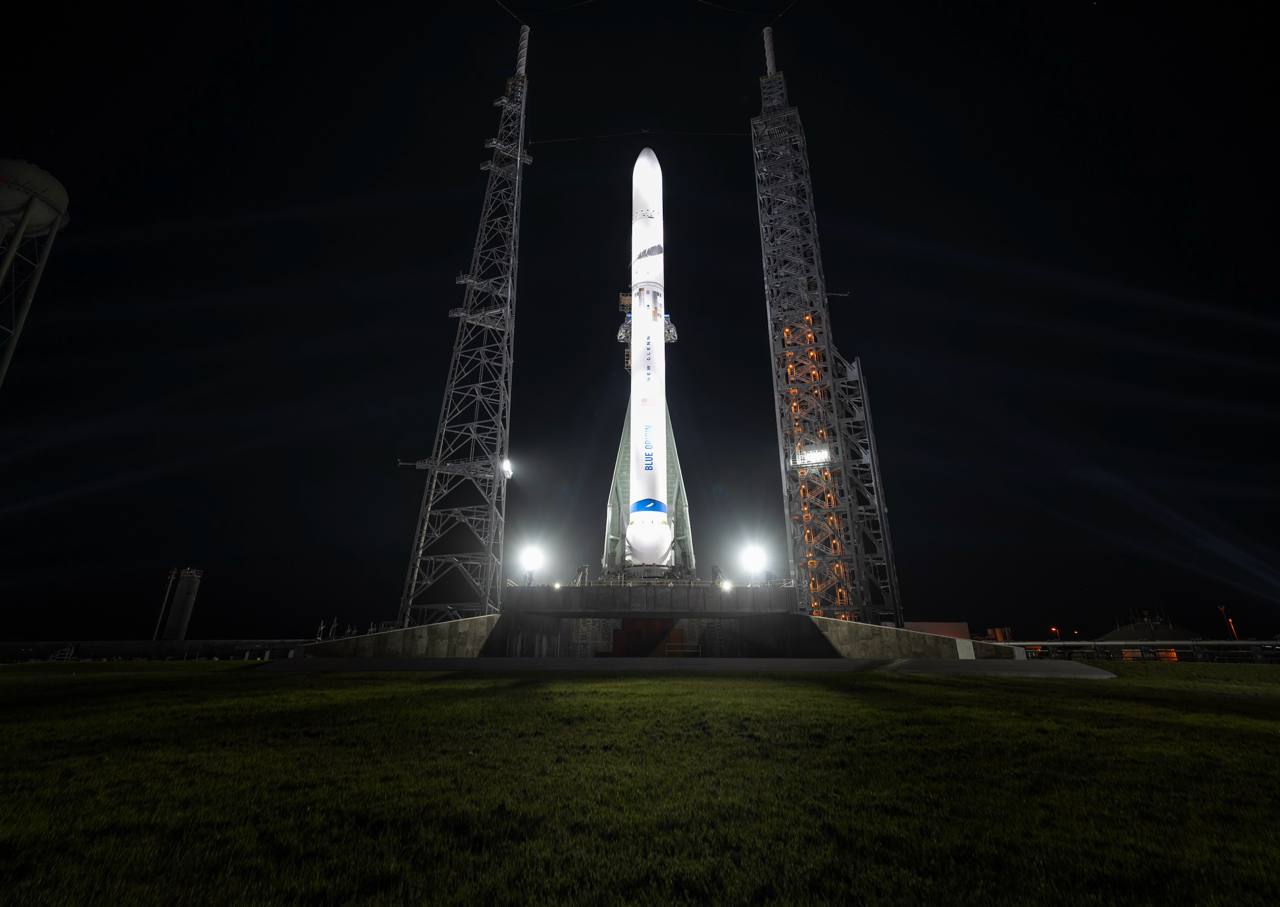
Blue Origin Rebuilds LC-36 Around New Operations Concept, Turns to Stennis for Second-Stage Testing
Two months after a New Glenn first stage exploded during a hotfire test at Launch Complex 36, Blue Origin is rebuilding its Florida launch site around an entirely new concept of operations while pursuing testing alternatives for the rocket's second stage. CEO Dave Limp continues to post construction updates as the company races toward a self-imposed end-of-2026 return-to-flight target. The May 28 anomaly destroyed the New Glenn first stage and heavily damaged LC-36 ahead of the vehicle's fourth
OST Staff · July 31, 2026
Two months after a New Glenn first stage exploded during a hotfire test at Launch Complex 36, Blue Origin is rebuilding its Florida launch site around an entirely new concept of operations while pursuing testing alternatives for the rocket's second stage. CEO Dave Limp continues to post construction updates as the company races toward a self-imposed end-of-2026 return-to-flight target.
The May 28 anomaly destroyed the New Glenn first stage and heavily damaged LC-36 ahead of the vehicle's fourth launch, toppling the lightning tower and destroying the transporter erector along with its hydraulic cylinders beyond repair. The tank farm, integration facility, water tower, and Vehicle Access Tower survived largely intact, giving Blue Origin a foundation to build from. Debris cleanup took just nine days, and surviving hardware inside the integration facility, including three second stages and the reflown booster Never Tell Me The Odds, has already returned to Blue Origin's Exploration Park campus.
Limp announced Monday that crews finished destacking the Vehicle Access Tower, removing the top six modules to begin integrating fluids and controls, including cryogenic systems, pneumatics, and mechanisms. Access floors will be added before restacking begins. On July 30, Limp said new doors are going up on the integration facility, with six panels on the building's north side, each 27 m tall and massing about 18,143 kg, combining for a door opening roughly 60 m wide. The south end will receive the same treatment next.
Rather than rebuild the transporter erector, Blue Origin is skipping to a horizontal-and-vertical hybrid concept of operations it had already been developing for its larger 9x4 New Glenn variant, a configuration with nine first-stage engines and four second-stage engines compared to the current vehicle's seven and two. Limp has said adapting the approach for LC-36 saved months. Under the plan, stages will be mated horizontally inside the integration facility, moved to the pad on a simplified transporter, and lifted vertical by a conventional crane onto a new launch mount. The cause of the explosion remains unclear, with Limp saying early analysis points toward the aft section of the first stage.
Blue Origin has found a workaround for one piece of qualification work. NASA and the company finalized an annex to a reimbursable Space Act Agreement this month to hot-fire New Glenn's second stage, designated GS2, on the B-2 position of the Thad Cochran Test Stand at NASA's Stennis Space Center, with testing targeted to begin as early as this fall. The GS2 will travel aboard the barge Pegasus, due at Kennedy Space Center in the second week of August. "Stennis helped take Americans to the Moon, and through this partnership, it will help take us back," Limp said.
Company leadership has not wavered from the end-of-2026 target, though some outside observers have called that timeline ambitious. NASA Administrator Jared Isaacman called the recovery progress "almost beyond impressive." The stakes reach beyond New Glenn itself. Blue Origin's uncrewed Blue Moon MK1 lander, named Endurance, is the designated lander for NASA's first Moon Base mission at the lunar south pole, a flight that now depends on New Glenn's return to flight.
Blue Origin filed four FAA antenna structure registrations on July 17 for lightning protection poles at the Merritt Island Launch Area, describing four steel mast structures roughly 42.7 m tall, a height that rules out support for a fully stacked New Glenn. Around the same time, a compact transporter erector previously used for second stages arrived at KSC. Blue Origin has not explained either development. GS2 testing at Stennis is targeted to begin as early as this fall.