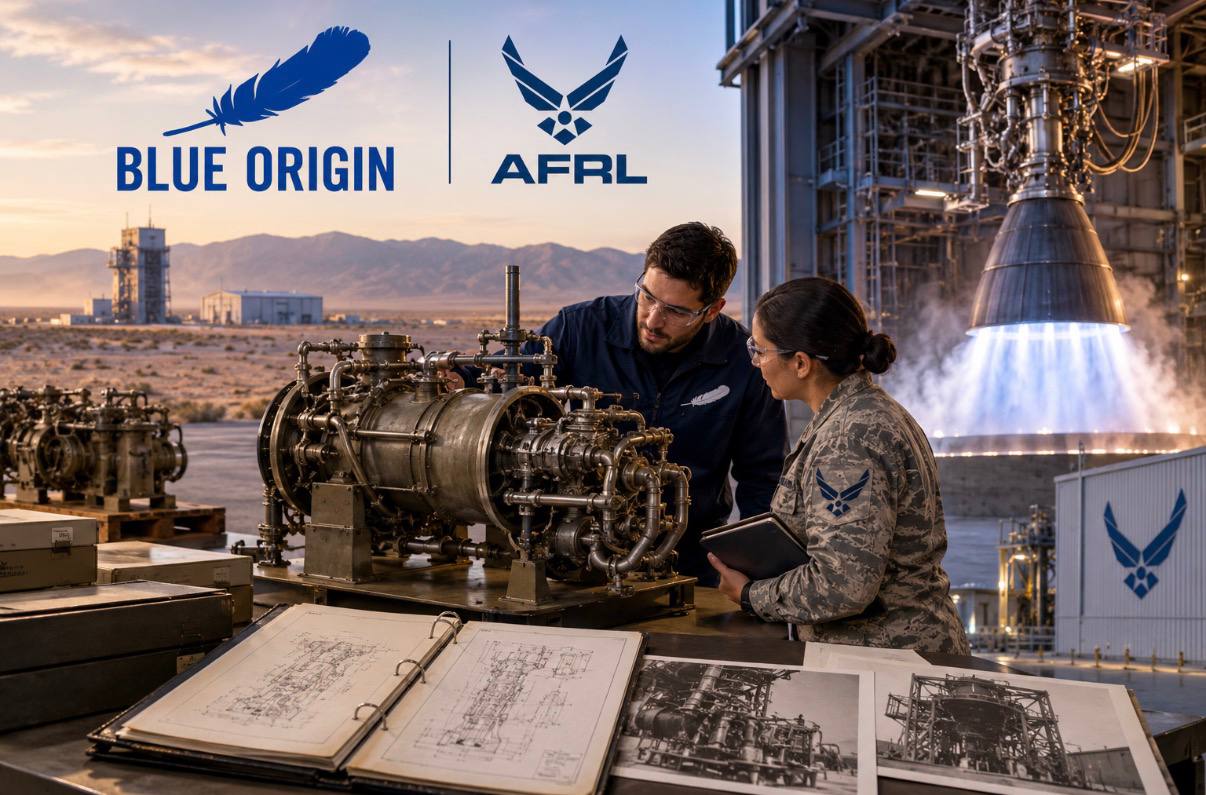
Blue Origin Gains Access to Historic Air Force Propulsion Hardware Under Expanded CRADA
Blue Origin and the Air Force Research Laboratory's Rocket and Space Propulsion Division at Edwards Air Force Base have signed a Cooperative Research and Development Agreement to transfer advanced rocket propulsion hardware and engineering artifacts to the company. The agreement gives Blue Origin access to material from AFRL's Hydrocarbon Boost and Integrated Powerhead Demonstrator programs to inform its commercial engine development. The HCB and IPD programs, developed decades ago, pioneered o
OST Staff · September 15, 2026
Blue Origin and the Air Force Research Laboratory's Rocket and Space Propulsion Division at Edwards Air Force Base have signed a Cooperative Research and Development Agreement to transfer advanced rocket propulsion hardware and engineering artifacts to the company. The agreement gives Blue Origin access to material from AFRL's Hydrocarbon Boost and Integrated Powerhead Demonstrator programs to inform its commercial engine development.
The HCB and IPD programs, developed decades ago, pioneered oxygen-rich and full-flow staged combustion technologies to advance liquid rocket propulsion capabilities in the United States. Under the new CRADA, Blue Origin will study this hardware and data as it works on next-generation propulsion technologies.
Nicholas Robertson, senior vice president of engines at Blue Origin, said the agreement expands the company's partnership with AFRL. "Studying these historic and technical artifacts grounds our engineering models in real government research," he said.
The CRADA builds on continuing collaboration between the two parties to test and mature the BE-7 lunar lander rocket engine at Area 1-42 High Altitude Rocket Test Facility, a national test asset located at AFRL Edwards. The BE-7 is a dual-expander cycle engine that delivers high specific impulse and deep throttling capabilities, characteristics the company describes as suited to carrying large payloads to the Moon. Testing of the engine has been conducted at atmospheric conditions equivalent to 80,000 feet at the laboratory's TS 1-42A.
Dr. Javier Urzay, chief of AFRL's Rocket and Space Propulsion Division, described the division's mission as discovering, developing, and delivering high-risk, high-payoff rocket, missile, and spacecraft propulsion technologies to support national security. He said the partnership and the material transfer from the HCB and IPD programs "ensure a continuous legacy of the science and technology investments we make to yield tangible capabilities for the nation in broadening and maintaining U.S. strategic advantage in space."
According to the parties, the arrangement allows government research investments to carry forward through a commercial partner while supporting Blue Origin's development of new propulsion systems. Urzay characterized Blue Origin as a strong commercial space partner in that effort.
The BE-7 engine testing continues at AFRL Edwards. No further milestones or decisions were named in the announcement.