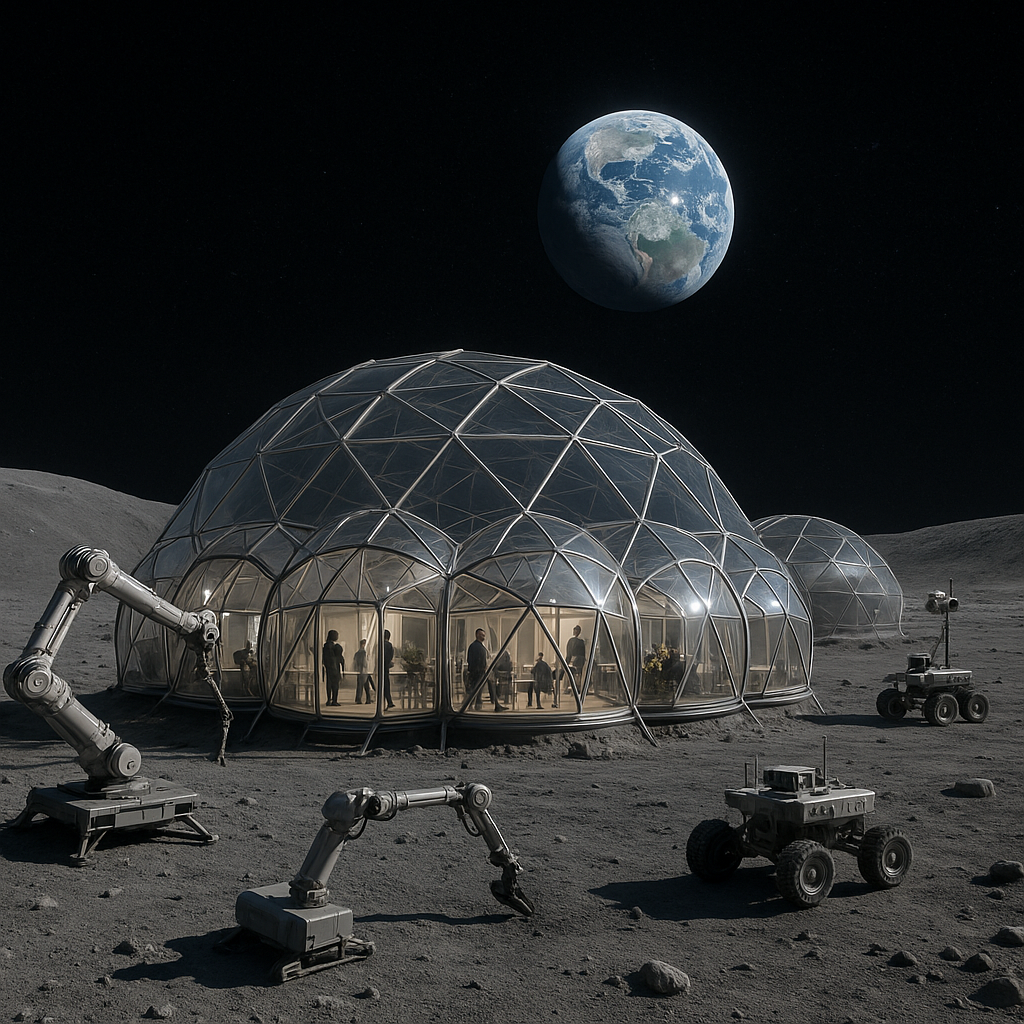
Bezos Forecasts Millions Living in Space by 2045, Robots Doing Lunar Work
Jeff Bezos predicts that millions of people could be living in space within two decades, with robots handling much of the physical labor on the Moon and beyond. The Amazon and Blue Origin founder laid out the vision at Italian Tech Week, pointing to accelerating advances in AI, automation and space technology. Bezos, who recently became the second richest person in the world after Blue Origin's valuation rose to $140 billion in its latest funding round, argued that technological progress is mov
OST Staff · October 18, 2026
Jeff Bezos predicts that millions of people could be living in space within two decades, with robots handling much of the physical labor on the Moon and beyond. The Amazon and Blue Origin founder laid out the vision at Italian Tech Week, pointing to accelerating advances in AI, automation and space technology.
Bezos, who recently became the second richest person in the world after Blue Origin's valuation rose to $140 billion in its latest funding round, argued that technological progress is moving fast enough to make large-scale human habitation in space achievable by 2045. He framed the shift as driven by choice rather than necessity.
"In the next kind of couple of decades, I believe there will be millions of people living in space," Bezos said, adding that the change could arrive far sooner than many expect. "That's how fast this is going to accelerate." He stressed that humanity would not be forced off Earth. "They'll mostly be living there because they want to. We don't need people to live in space," he said.
On lunar operations, Bezos said robots would carry out most of the work required on the Moon and elsewhere, lowering costs and improving efficiency. "If you need to do some work on the surface of the moon or anywhere else, we will be able to send robots to do that work, and that will be much more cost-effective than sending humans," he said. He argued that advances in AI and robotics would cut the need for people to take on risky or expensive off world assignments while enabling greater exploration and development beyond Earth.
Bezos also offered an optimistic view of artificial intelligence, countering warnings that it could eliminate jobs or pose broader risks. He said innovation has historically increased prosperity. "Civilizational abundance comes from our inventions," he said, comparing AI to transformative technologies such as the plough. "These tools increase our abundance, and that pattern will continue."
Bezos presented the outlook as his own belief about the direction and speed of technological change, tying large-scale space habitation, robotic labor and AI together as mutually reinforcing forces that he expects to expand human activity beyond Earth over the coming decades.
The remarks were delivered at Italian Tech Week, where Bezos set out his timeline of roughly two decades for millions of people living in space and for robots taking over much of the work on the Moon and other locations.