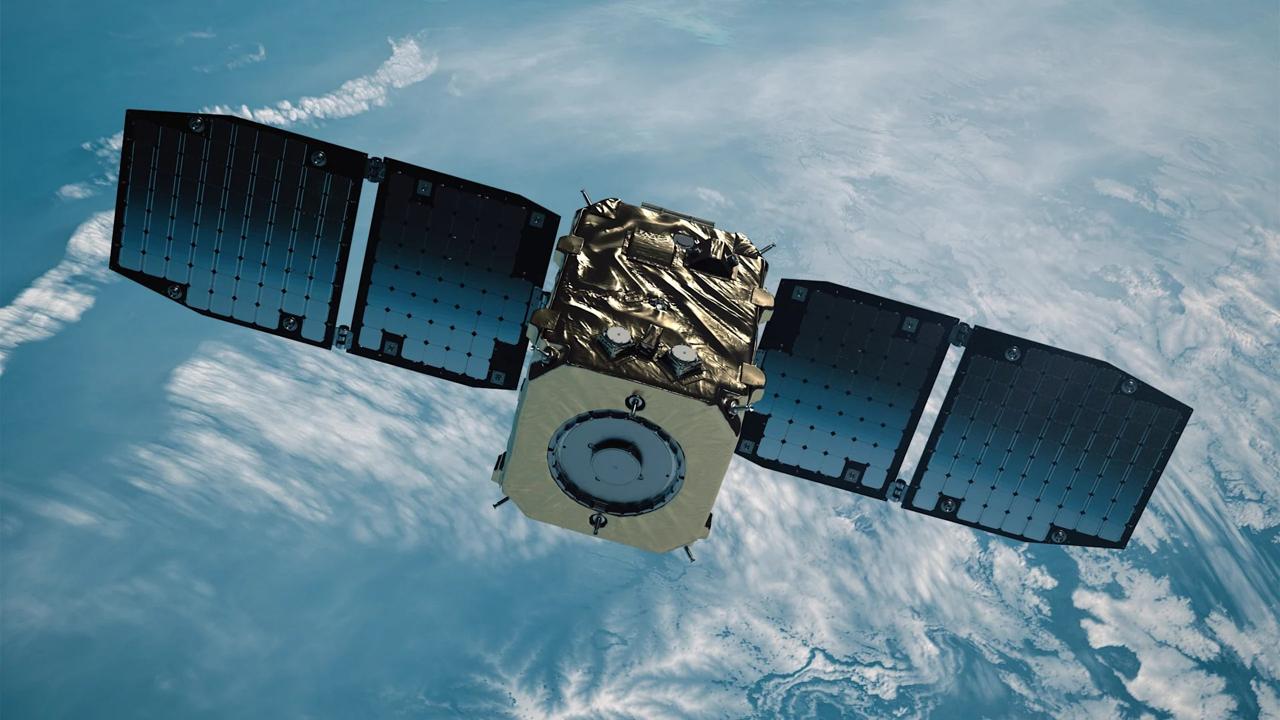
Astroscale Pitches 'Bodyguard' Satellites Built From Debris-Removal Technology
Astroscale says the same spacecraft technologies it developed to remove space junk and service broken satellites could be repurposed into fleets of protector spacecraft that shield high-value satellites from adversary attacks. The company believes it could have a protector spacecraft ready for launch in under three years. The idea is a proposal, not a funded program. The pitch comes as Western space assets face mounting threats from Russia. Astroscale conducted an up-close in-orbit inspection o
OST Staff · October 27, 2026
Astroscale says the same spacecraft technologies it developed to remove space junk and service broken satellites could be repurposed into fleets of protector spacecraft that shield high-value satellites from adversary attacks. The company believes it could have a protector spacecraft ready for launch in under three years. The idea is a proposal, not a funded program.
The pitch comes as Western space assets face mounting threats from Russia. Astroscale conducted an up-close in-orbit inspection of a discarded Japanese rocket stage during its ADRAS-J mission in low Earth orbit in 2024, and its ELSA-D mission, which ran from 2021 to 2024, was the first commercial endeavor to demonstrate orbital capture technologies in LEO. Those capabilities, the company argues, translate directly to defending satellites in orbit.
Alex Godfrey, Astroscale's head of defense, spoke on the sidelines of a London event earlier this month. He said that in in-orbit servicing the company must achieve very high levels of agility to dock and close to a distance of zero meters, while space control operations rarely require getting as close, making them in some ways simpler. His remarks came just as Russia made close-up maneuvers around a radar satellite owned by Finland-headquartered Earth-observation company ICEYE. The October incident was described by experts as the first rendezvous of two active satellites in LEO conducted without the consent of the target, and raised concerns Russia may be preparing to damage the satellite, part of a fleet providing intelligence to Ukraine. U.S. Under Secretary of State Thomas G. DiNanno described Russia's actions on X as "threatening behavior" and "consistent with on-orbit weapons operations."
Godfrey said a bodyguard mission would cost on the order of a single percent of the value of a military-grade geostationary communications constellation such as the U.K.'s £8.4-billion Skynet fleet. "To build a bodyguard satellite is absolutely within the capability and the budget of a single country like the U.K.," he said, comparing the concept to a carrier strike group in which the carrier never leaves port alone but travels with lower-cost escorts. He proposed a pan-European fleet of orbital bodyguards patrolling clusters of allied assets, suggesting nations form a geo-patrol force through collaboration, with one spacecraft protecting two or three allied satellites positioned near one another.
Astroscale, headquartered in Japan with a significant presence in the U.K., is a leader in commercial orbital rendezvous and proximity operations technology, but no Western players currently match the deployed capabilities of Russia and China. Russia's Luch-1 and Luch-2 satellites have stalked European and American communications satellites in geostationary orbit since 2014, and Germany's military space command chief Major General Michael Traut acknowledged this year that the Luch spacecraft have been spying on European strategic communications for years.
The proposal reflects how a company built to clean up orbit now positions itself as an orbital defender. Nick Shave, Astroscale's U.K. managing director, said the company is in discussions with companies and customers across Europe, though it has signed no contracts to develop bodyguard satellites. "We have spent a good amount of time talking over the last few years, but now we have to go and really deliver," Shave said.
Shave noted that the U.K. government is promising funding for space control development from 2030 onwards, and said the task now is to prepare the right capabilities, investment and demonstrator capability by 2030. In the meantime, Russia's COSMOS 2612 stalker satellite continues lingering 298 miles from the ICEYE satellite in LEO.