Asteroid Shape Determines Nuclear Deflection Success, New Sandia Study Finds
New research shows that the irregular shapes of asteroids dramatically affect how well a nuclear radiation pulse could deflect one from a collision course with Earth. A study published in Icarus found that the orientation of an asteroid at the moment of intercept can increase deflection velocity by up to five times, depending on which surface faces the blast. The work addresses a scenario considered an option of last resort: deflecting a near Earth object or comet discovered too late for a simp
OST Staff · November 5, 2026
New research shows that the irregular shapes of asteroids dramatically affect how well a nuclear radiation pulse could deflect one from a collision course with Earth. A study published in Icarus found that the orientation of an asteroid at the moment of intercept can increase deflection velocity by up to five times, depending on which surface faces the blast.
The work addresses a scenario considered an option of last resort: deflecting a near Earth object or comet discovered too late for a simple kinetic impactor to work. In that case, researchers argue, late interception might only be possible with the higher energy concentration of a pulsed energy device, meaning a nuclear weapon. Rather than obliterating the asteroid, the weapon would be detonated at a distance to bombard it with radiation, a method called a stand off X-ray mitigation scenario. In space there is no atmospheric shock wave, only a powerful radiation pulse.
The effectiveness of deflecting asteroids with pulsed radiation is difficult to quantify because it hinges on surface topography, which is often unknown, the authors write. Lead author Nathan Moore, a physicist at Sandia National Laboratories, and his colleagues developed a new algorithm to simulate this process on irregularly shaped bodies. Previous research had focused largely on spherical asteroids because irregular shapes were too difficult to model. The new algorithm is over 1,600 times faster, Moore said, which was critical to the breakthrough. With the old models, computers could not handle the task.
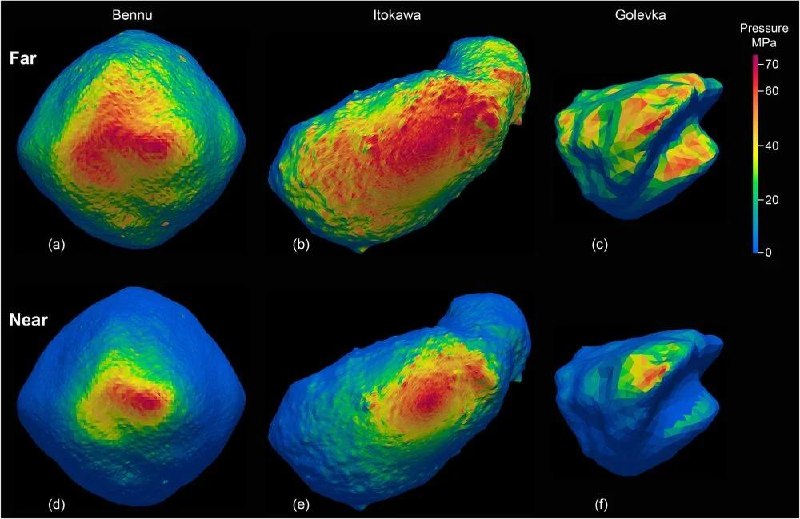
The researchers simulated the deflection of three real asteroids with different shapes: Bennu, Itokawa, and Golevka, using both near field and far field irradiations. When a device detonates near an asteroid, an intense X-ray pulse strikes one side, causing rapid surface vaporization that generates most of the deflection thrust. An internal shock wave then travels through the body, fracturing its structure and potentially blowing chunks off the opposite surface and sides.
The results showed that orientation at the time of intercept could increase deflection velocity by up to nearly two times for Bennu, four times for Itokawa, and five times for Golevka, compared to the minimum response for each body. We expected aim to matter, Moore said. What surprised us was how much. The study notes that stand off bursts may permit deflection with less disruption to the asteroid's structure than a surface explosion, allowing more controlled steering. Disrupting the original structure could multiply the hazard to Earth by creating a swarm of debris, some of which could strike the planet.
The authors say the strong sensitivity of deflection to topography is especially pertinent because the shape of an incoming object might not be known, and its orientation at intercept may be uncontrolled. The simulation can be applied to any asteroid mapped by a spacecraft during a flyby, calculating in advance the explosion size, distance, and exposed surface to determine how hard the asteroid will be pushed, how fast it will rotate, and how much surface might break up.
The model has limits. It currently considers only the breakup of surface rocks and cannot yet accurately predict breakup of the entire asteroid body, Moore said. Interior structures vary and remain beyond the model's capabilities. The authors suggest that high resolution topographic characterization of an incoming object, obtained through spacecraft observation, could improve the accuracy of the deflection model.