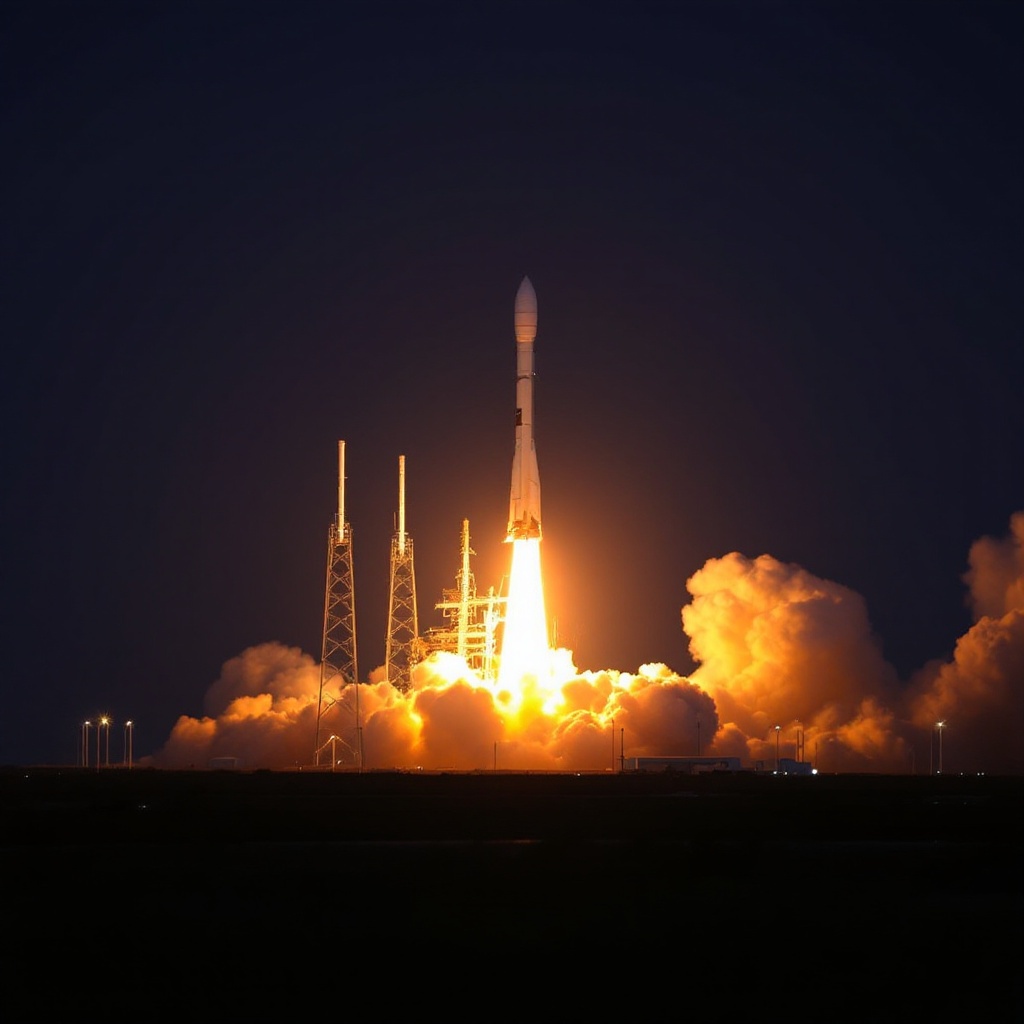
SpaceX Delivers Three More BlueBird Satellites to Orbit for AST SpaceMobile
A SpaceX Falcon 9 launched three of AST SpaceMobile's BlueBird Block 2 satellites into low Earth orbit before dawn on Wednesday, adding satellites numbered 11, 12, and 13 to the company's direct-to-device constellation. The mission marks the latest step in building out a network designed to deliver cellular broadband straight to standard smartphones. The launch came about a month and a half after SpaceX flew the BlueBird 8-10 mission. It was the third time SpaceX has carried satellites for AST
OST Staff · August 5, 2026
A SpaceX Falcon 9 launched three of AST SpaceMobile's BlueBird Block 2 satellites into low Earth orbit before dawn on Wednesday, adding satellites numbered 11, 12, and 13 to the company's direct-to-device constellation. The mission marks the latest step in building out a network designed to deliver cellular broadband straight to standard smartphones.
The launch came about a month and a half after SpaceX flew the BlueBird 8-10 mission. It was the third time SpaceX has carried satellites for AST SpaceMobile's constellation, which aims to connect standard phones without any special hardware.
Liftoff from Space Launch Complex 40 at Cape Canaveral Space Force Station occurred at 3:49 a.m. EDT (0749 UTC), with the rocket flying a northeasterly trajectory. The 45th Weather Squadron forecast an 85 percent chance of favorable weather, while tracking possible interference from anvil, thick, and cumulus clouds. Launch weather officers noted that a weak mid-level low centered over Georgia would begin to dissipate overnight, leaving light southwesterly flow during the primary launch window.
The mission flew on Falcon 9 first stage booster B1077, which became the fifth Falcon booster to reach at least 30 flights. Four of those five boosters remain in operation. More than 8.5 minutes after liftoff, B1077 landed on the droneship A Shortfall of Gravitas in the Atlantic Ocean, the 162nd landing on that vessel and the 645th Falcon booster landing to date.
The three BlueBird satellites were deployed several minutes apart beginning about 54 minutes after liftoff. Because of the size of the payload adaptor, SpaceX did not broadcast the deployment live, instead confirming the release on social media at 6:09 a.m. EDT. The 2,400 square foot satellites will take a couple of weeks to deploy to full size and complete checkouts before joining the broader constellation.
In late July, AST SpaceMobile CEO Abel Avellan said on social media that the next trio of satellites are not far behind, with production in flow through satellite 42. "We invented a new way to design, manufacture at scale, deploy, and fly lightweight composite stackable architecture combined, with the world's largest and most advanced direct-to-device and radar phased-array with the ability to launch them in groups of 3, 5, 6, or 8 on a single launch," Avellan wrote.
The Falcon 9 can launch a maximum of three BlueBird satellites at once, with the eight-satellite configuration reserved for Blue Origin's New Glenn rocket and its seven-meter diameter payload fairing. New Glenn is grounded for an undetermined period following a May 28 pad explosion.
Avellan indicated that BlueBirds 14, 15, and 16 will follow right after this launch, with production advancing through BlueBird 42. The satellites are built in Texas.