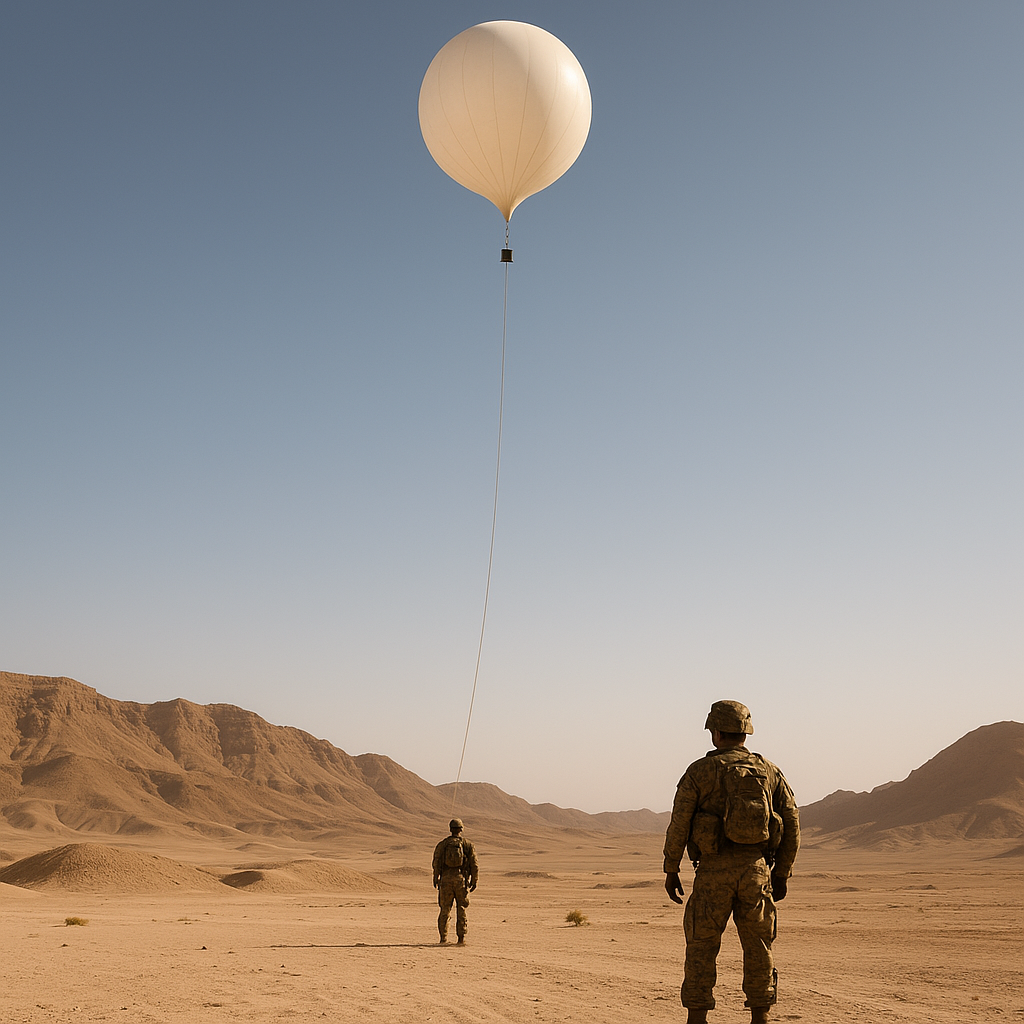
Army Space Command Chief Calls High-Altitude Balloons a "Game-Changing" Capability
The head of the U.S. Army Space and Missile Defense Command, once a skeptic, now describes high-altitude balloons as a game-changing capability for the service. Lt. Gen. John Rafferty's comments came as the Army disclosed it scrapped a planned balloon swarm test in the Pacific last year and redirected those systems to support real operations in the Middle East. Rafferty spoke during a media roundtable on the sidelines of the Association of the U.S. Army's annual convention. Army Col. Joseph Mro
OST Staff · October 14, 2026
The head of the U.S. Army Space and Missile Defense Command, once a skeptic, now describes high-altitude balloons as a game-changing capability for the service. Lt. Gen. John Rafferty's comments came as the Army disclosed it scrapped a planned balloon swarm test in the Pacific last year and redirected those systems to support real operations in the Middle East.
Rafferty spoke during a media roundtable on the sidelines of the Association of the U.S. Army's annual convention. Army Col. Joseph Mroszczyk, head of SMDC's Transformation Integration Directorate for Space Superiority, also addressed the service's balloon efforts. The shift of balloon-based capabilities from the Pacific to U.S. Central Command was first reported Monday by Breaking Defense.
Rafferty recounted his early doubts. "There was this talk of high-altitude balloons. I think it was the ISR task force was talking about it," he said. "It just sounded crazy to me that we were considering this." He said his view changed after traveling with the 2nd Multi-Domain Task Force to Morocco for training and experimentation. "I saw the high-altitude balloons in action, and I was immediately convinced after I understood better how they worked and how their ability to station-keep, and their ability to sense and even deliver effects from high altitude. It was game-changing for me."
Mroszczyk said he is pushing for a family of stratospheric systems spanning smaller to larger platforms. "What that enables us to provide is space-like capabilities, really exploiting a transition point between what is normally considered the aerial layer and the space domain," he said, identifying the focus area as roughly 60,000 to 100,000 feet. He said that operational space allows persistence and broad coverage while delivering space-like payloads and taking advantage of the deep access a stratospheric balloon provides. He added the Army is looking to run multiple experiments over the coming year, including demonstrations of how balloons will be commanded, controlled, and networked with other Army capabilities.
Andrew Evans, Director of Strategy and Transformation with the Office of the Deputy Chief of Staff of the Army, told Breaking Defense the service pivoted to support operations in CENTCOM. "They were effective for the mission that they were assigned," he said, declining to elaborate. Evans noted operational lessons about vendor relationships and environmental limits. "Balloons can be a little finicky in terms of temperature, and you have to contend with environmental characteristics," he said. He described learning "where those friction points might exist between what the military might need to inherently own, and what a vendor could help provide in terms of the service."
The main benefits cited for modern high-altitude balloons are persistence, with deployments lasting days, weeks, or months, and the ability to station-keep and moderate altitude despite prevailing winds. From 60,000 feet or more, their sensors gain wide fields of view and can peer into denied areas while remaining in international airspace. Beyond ISR, Rafferty noted the balloons can serve as communications relay nodes and as launch platforms for swarms of drones and other expendable payloads.
The remarks underscore the Army's commitment to fielding new balloon-based capabilities, though the continued emphasis on testing and experimentation highlights a gap between the service's stated ambitions and the current state of its efforts.
The Army plans to conduct multiple balloon experiments over the coming year, including further demonstrations of command and control and networking with other systems.