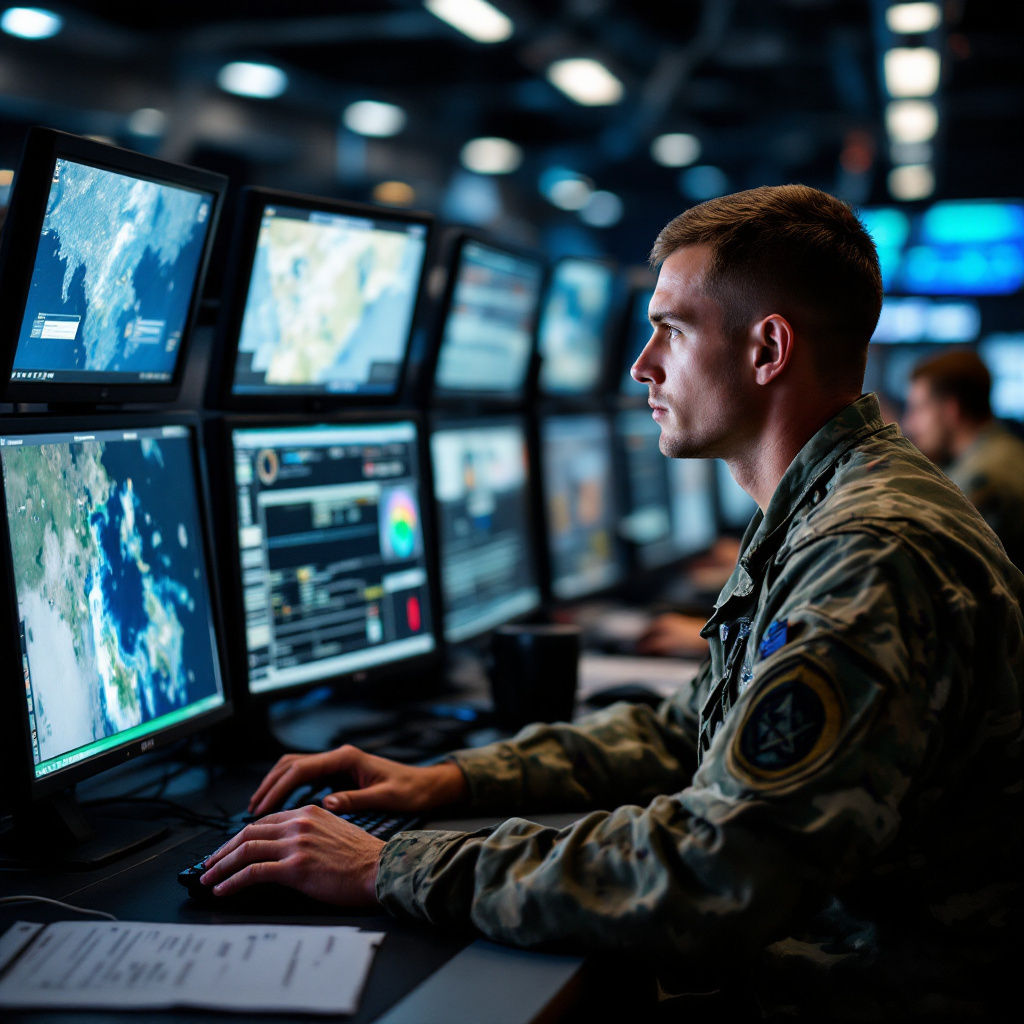
Army Moves to Grow Space Operations Branch to Thousands of Soldiers
The U.S. Army plans to expand its newly created Space Operations Branch to include thousands of officers and enlisted troops in the coming years, officials said this week. The growth follows the transfer of 600 enlisted Soldiers into the branch on Oct. 1, part of a broader effort to professionalize the service's space workforce. The Army established the Space Operations Branch in June, consolidating space-related career paths to train Soldiers to operate and deploy space systems. The move comes
OST Staff · October 16, 2026
The U.S. Army plans to expand its newly created Space Operations Branch to include thousands of officers and enlisted troops in the coming years, officials said this week. The growth follows the transfer of 600 enlisted Soldiers into the branch on Oct. 1, part of a broader effort to professionalize the service's space workforce.
The Army established the Space Operations Branch in June, consolidating space-related career paths to train Soldiers to operate and deploy space systems. The move comes as the service seeks to deepen its own space expertise, having long relied on space capabilities to navigate terrain, communicate in hard-to-reach areas, and identify and strike targets.
The 600 enlisted Soldiers transferred Oct. 1 were reclassified as 40D Tactical Space Operations Specialists, the Military Occupational Specialty code for the Army's space troops. The move united them with 40A Space Operations Officers. The enlisted Soldiers had previously been temporarily reassigned to space-related units from Air Defense Artillery, Signal, and Military Intelligence fields.
Col. Joseph Mroszczyk, director of the Army's Transformation Integration Directorate for Space Superiority and High Altitude, told reporters Oct. 14 during the Association of the U.S. Army Annual Meeting in Washington that the service's space operations cadre has almost doubled since 2012, and he expects that growth to continue. "When we talk about the branch and the targets, having a couple thousand dedicated folks within the branch, between the enlisted and the officer side, is a significant contribution across the service," Mroszczyk said. He did not offer specifics on how long reaching that level might take.
Army officials have continued to make the case that the service needs its own space-focused Soldiers, even as critics charge the effort risks duplicating work done by the Space Force and blurring roles and missions. The Army says the Space Force is focused on maintaining space superiority in orbit, while its own role is integrating space capability and effects into tactical multidomain operations from the ground. The Space Force was created in 2019, with space operators and units transferring from the Air Force, Navy, and Army, the bulk coming from the Air Force.
Lt. Gen. John Rafferty, commander of the Army's Space and Missile Defense Command, said in an Oct. 13 interview that as demand for these capabilities grows, the Army needs to provide the same professional pathways and training for space operators that it does for other specializations such as artillery, infantry, and aviation. "Training, education, experience, and talent management is how you create great leaders, and that's how you build great units with great leaders," Rafferty said. "It became apparent to the Army that in order to capitalize on the momentum, the gains that we've made in Army space-delivered capabilities, we need to professionalize the branch and do it fast."
Rafferty pointed to several areas where the Army expects to need more space personnel. The service activated a new Multi-Domain Task Force at Fort Carson, Colo., on Oct. 8, one of four elements stationed around the world and designed to integrate air, land, sea, space, and cyber operations in theater. A fifth is slated for activation in 2028, and each task force incorporates space effects. Rafferty also pointed to the creation of a new Theater Strike Effects Group at U.S. Army Pacific, which will require space support. The service wants to expand the focus of its 1st Space Brigade, headquartered at Fort Carson and distributed across six countries, beyond GPS, theater missile warning, and satellite communications into new capability areas. He did not provide details.