Army Awards First U.S. Production Contract for a High-Energy Laser Weapon
The U.S. Army has awarded AeroVironment a contract worth $464.8 million for the Enduring High-Energy Laser program of record, marking what the service calls its first-ever production contract for a high-energy laser weapon. The award will bring AeroVironment's LOCUST X3 counter-drone laser system into production, crossing the line from prototype to fielded capability. The Army announced the award on September 2, 2026, framing it as a directed-energy program built to defeat unmanned systems. Ahe
OST Staff · September 3, 2026
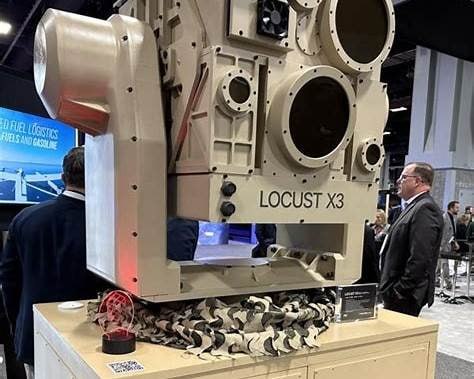
The U.S. Army has awarded AeroVironment a contract worth $464.8 million for the Enduring High-Energy Laser program of record, marking what the service calls its first-ever production contract for a high-energy laser weapon. The award will bring AeroVironment's LOCUST X3 counter-drone laser system into production, crossing the line from prototype to fielded capability.
The Army announced the award on September 2, 2026, framing it as a directed-energy program built to defeat unmanned systems. Ahead of the public announcement, AeroVironment executives briefed reporters on the award and its scope.
Gen. Christopher LaNeve, the acting chief of staff of the Army, said the effort would let formations defeat unmanned systems and dominate from the outset. "Pairing human ingenuity with advanced technology is what ensures our Army will continue to outpace America's adversaries," he said in the announcement.
The LOCUST X3 is the third LOCUST system in AeroVironment's catalog and is designed to take down drone threats up to Group 3 using a 30-kilowatt laser. Group 3 drones weigh up to 1,320 pounds. The system is powered by electric energy and produces what the Army described as a lethal high-energy laser beam. The Army said directed-energy systems such as E-HEL can defeat drones at a much lower cost than kinetic weapons such as missiles.
The award is structured as an Other Transaction Authority agreement. John Garrity, AeroVironment's vice president of directed-energy systems, said the company will deliver dozens of LOCUST X3 systems over the next few years, with initial capabilities delivered within the year. He said the company was previously scaling tens of systems annually and is now capable of scaling into the 20s per year, expecting to grow well beyond that over the coming 12 to 24 months. "One of the key exciting components of this particular production program is introducing production-directed energy for the first time in the nation's history," Garrity said. He added that the LOCUST family of systems has an overall kill count in the thousands on test ranges.
The announcement signals the Army believes the technology is mature enough to manufacture at scale. Garrity said the LOCUST X3 is purpose-built for all types of warfare and environments, and he expected the systems to be deployed across all combatant commands. Citing drones used by Iran in current operations, he said warfighters and allies need a capability purpose-built to counter Group 3 threats while also addressing smaller Group 1 and Group 2 drones, which range from less than 20 pounds up to 55 pounds.
Garrity said he first envisions the systems mounted on the Army's Joint Light Tactical Vehicles and Infantry Squad Vehicles, and eventually on heavier platforms such as Strykers. He described the system as platform agnostic, expressing hope it could be incorporated onto tanks, robots, ships, and vessels. The award follows the deployment of AeroVironment's 20-kilowatt LOCUST system near the Southern Border in El Paso, Texas, and recent testing before Defense Secretary Pete Hegseth and Army Secretary Dan Driscoll at White Sands Missile Range in New Mexico. The LOCUST X3 was unveiled in March. AeroVironment plans to deliver initial capabilities within the year.