Air-Breathing Plasma Thruster Aims to Keep Satellites Aloft in Very Low Earth Orbit Indefinitely
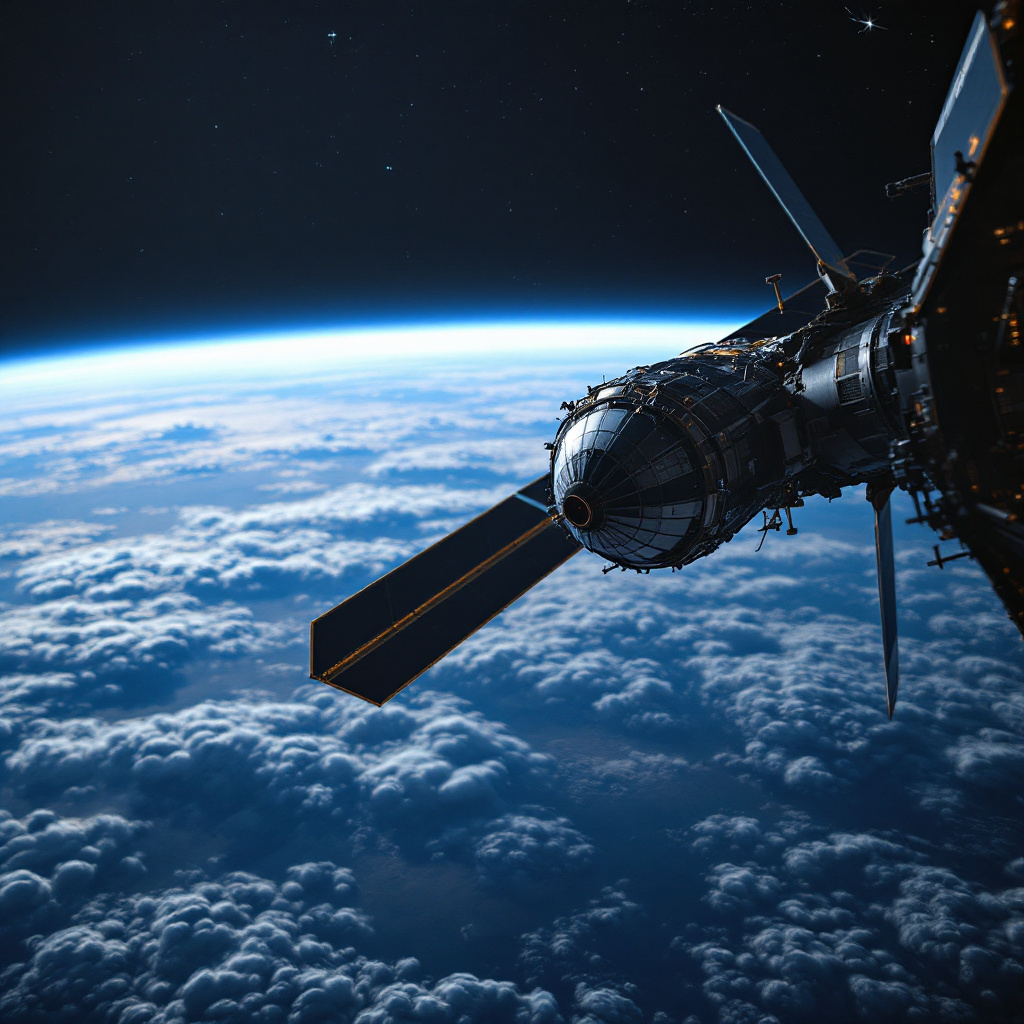
A new plasma engine design uses the thin atmosphere itself as propellant, potentially allowing satellites to remain in Very Low Earth Orbit without carrying fuel. The concept, developed by Francesco Romano as part of his PhD thesis at the University of Stuttgart, addresses the persistent drag problem that forces spacecraft in these low orbits to fire engines almost constantly. Very Low Earth Orbit, between 100 and 450 km, offers distinct advantages. Remote sensing cameras capture sharper images
OST Staff · September 12, 2026
A new plasma engine design uses the thin atmosphere itself as propellant, potentially allowing satellites to remain in Very Low Earth Orbit without carrying fuel. The concept, developed by Francesco Romano as part of his PhD thesis at the University of Stuttgart, addresses the persistent drag problem that forces spacecraft in these low orbits to fire engines almost constantly.
Very Low Earth Orbit, between 100 and 450 km, offers distinct advantages. Remote sensing cameras capture sharper images, communications and radar systems require less power, and atmospheric drag automatically deorbits dead satellites. The trade-off is that the same air friction forces any satellite in this orbit to run an engine near constantly, which traditionally requires expensive gases such as Xenon. Romano's approach, a form of Atmosphere-Breathing Electric Propulsion, scoops up thin air ahead of a spacecraft, converts the molecules into plasma, and expels them to produce thrust.
Two technical obstacles complicated the design. Atomic Oxygen, formed when UV radiation splits O2 in the upper atmosphere, is highly oxidative and corrodes metal electrodes, acceleration grids, and the cathodes used to neutralize spacecraft charge in conventional ion engines. Without neutralization, charged particles are drawn back to the spacecraft, nullifying thrust. The variability of the atmosphere, which changes with the day-night cycle, latitude, and solar activity, has also made continuous operation difficult.
Romano developed a contactless, neutralizer-less Radio-Frequency Helicon Plasma Thruster paired with an optimized intake. He trialed three intake designs: an enhanced funnel that traps widely spaced particles, a diffuse hexagonal intake made from coated titanium alloy, and a specular intake using a parabolic mirror coated with graphite or silicon dioxide. The specular design won on both collection efficiency and alignment sensitivity, capturing roughly 94.3 percent of air particles in wind tunnel tests using Atomic Oxygen, argon, or nitrogen, with efficiency dropping only 8 percent under a 15 degree tilt.
For the thruster, Romano drew on medical technology, using a birdcage antenna similar to those in MRI machines. The design delivered 99 percent of electrical power into the thruster, exceeding standard wire coils that lose power to reactance. A solenoid wrapped around the engine creates a magnetic field that ejects the plasma as a quasi-neutral jet of both positive and negative ions, removing the need for a neutralizer. In vacuum chamber testing simulating VLEO gas concentrations, the engine produced steady plasma streams on only 50 to 60 watts of RF power, within the reach of standard spacecraft solar panels.
Romano applied propulsion models to real cases, including the GOCE satellite, which launched into VLEO with a Xenon ion thruster and eventually ran out of fuel. His calculations indicate the new engine could operate indefinitely between 190 and 250 km using less than 1.6 kW, still within the limits of standard solar panels. On Mars, whose atmosphere is dominated by CO2, the thesis states the engine could sustain a spacecraft indefinitely at 120 to 160 km, far closer to the surface than existing orbital satellites.
There is no guarantee the thruster will ever operate outside a laboratory. The source notes the idea holds potential commercial applications if it can be de-risked and proven on an actual mission, though whether Romano intends to pursue that path is unclear.
The work remains at the experimental validation stage. Any operational use would depend on further de-risking and a demonstration on a real mission, neither of which is confirmed in the thesis.