Spent Falcon 9 Stage Set to Strike the Moon on August 5, Offering a Live Test for Impact Science
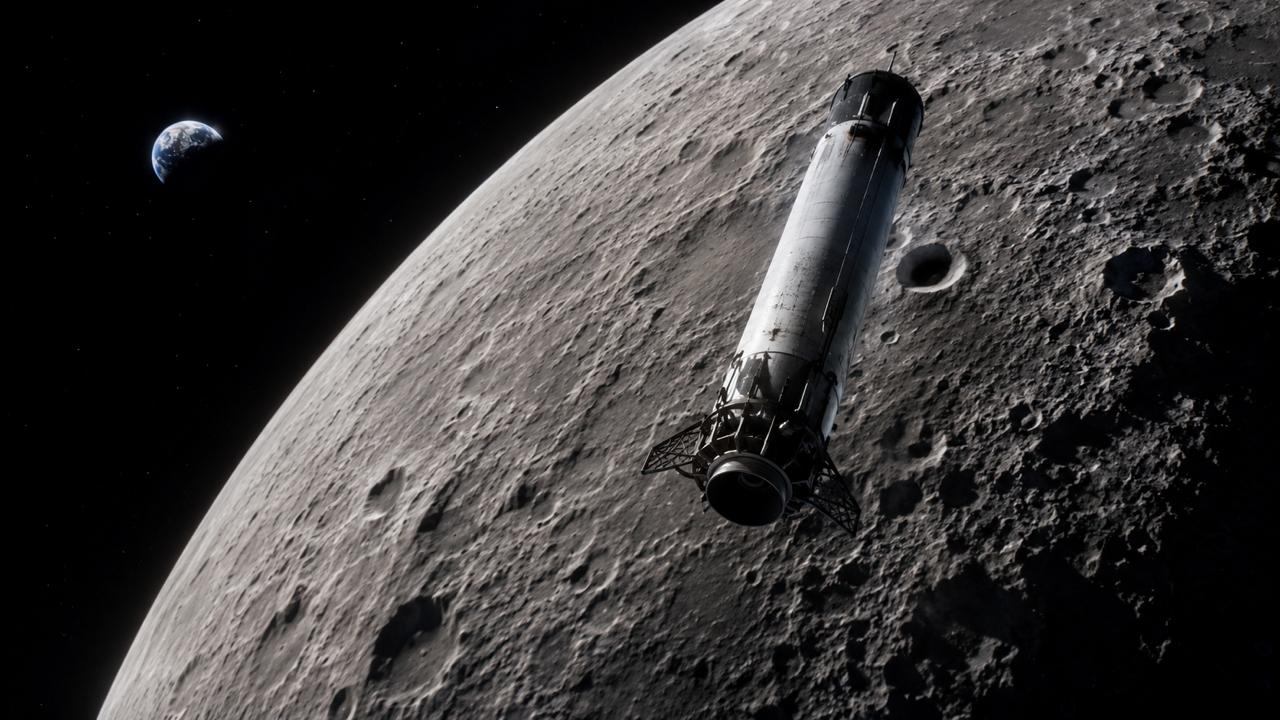
A discarded SpaceX Falcon 9 upper stage is on course to slam into the lunar surface on August 5, near the Einstein and Bell craters on the western lunar limb. Researchers say the high-speed collision could produce an ejecta plume briefly bright enough to be seen from Earth through sensitive telescopes, and they are preparing to use the event to calibrate models of how human-made objects disturb the moon. The stage is a leftover from the launch that carried Firefly's Blue Ghost-1 lander to the m
OST Staff · July 30, 2026
A discarded SpaceX Falcon 9 upper stage is on course to slam into the lunar surface on August 5, near the Einstein and Bell craters on the western lunar limb. Researchers say the high-speed collision could produce an ejecta plume briefly bright enough to be seen from Earth through sensitive telescopes, and they are preparing to use the event to calibrate models of how human-made objects disturb the moon.
The stage is a leftover from the launch that carried Firefly's Blue Ghost-1 lander to the moon on January 15, 2025. That same flight also carried the Hakuto-R Mission 2 lander, called Resilience, developed by the Japanese company ispace.
An international team led by William Jo, a graduate research assistant at the University of Texas, Austin, used physics simulations to model the impact. Their calculations predict the central ejecta spike will reach roughly 47 miles to more than 60 miles, or 75 to 100 kilometers, in altitude. "Our calculations suggest the plume should be several orders of magnitude brighter than the dark-sky background for the first few minutes after impact," Jo said. He cautioned that the figures represent a single nominal case and are on the optimistic side. "The point worth making is that the flash isn't really the story here."
Separate research led by Benjamin Fernando of the Los Alamos National Laboratory found the impact flash and ejecta plume are "potentially observable" from ground and space-based facilities, though many properties, such as visual magnitude, remain imprecisely predicted. Fernando's team reported that the maximum ballistic range of resolved particles is found to be slightly under 1,000 kilometers, "far enough to be significant from the perspective of presenting a hazard to future astronauts or infrastructure across much of the lunar surface."
Jo noted that a spent rocket stage is a hollow, spacecraft-like body, and few impact models exist for human-made objects, which appear to produce very different plumes than natural impactors like asteroids or comets. He stressed the scientific value lies in the moments after impact. "Watching this one gives us a rare chance to open up ejecta-plume science and calibrate those models against a real event, which matters for every future thing we deliver to the moon," he said. His concern is that "most observers will stop at the sub-second flash and never track down the ejecta, which is the part that should actually be visible, and where the science is."
The researchers say the event offers an opportunity to record an artificial impact in real time, to test a pipeline for localizing impacts for future seismic experiments, to investigate dust and plume dynamics, and to consider hazards from artificial debris that future lunar astronauts might need to avoid.
NASA's Lunar Reconnaissance Orbiter will pass over the projected crash site about seven days before and seven days after the impact. Brent Garry, an LRO project scientist at Goddard Space Flight Center, said imaging after the event could refine the location. "After the impact we might have a little bit more knowledge of where it is. We can do some additional targeting about a week after the impact and get some targeting over where the site is," Garry said.