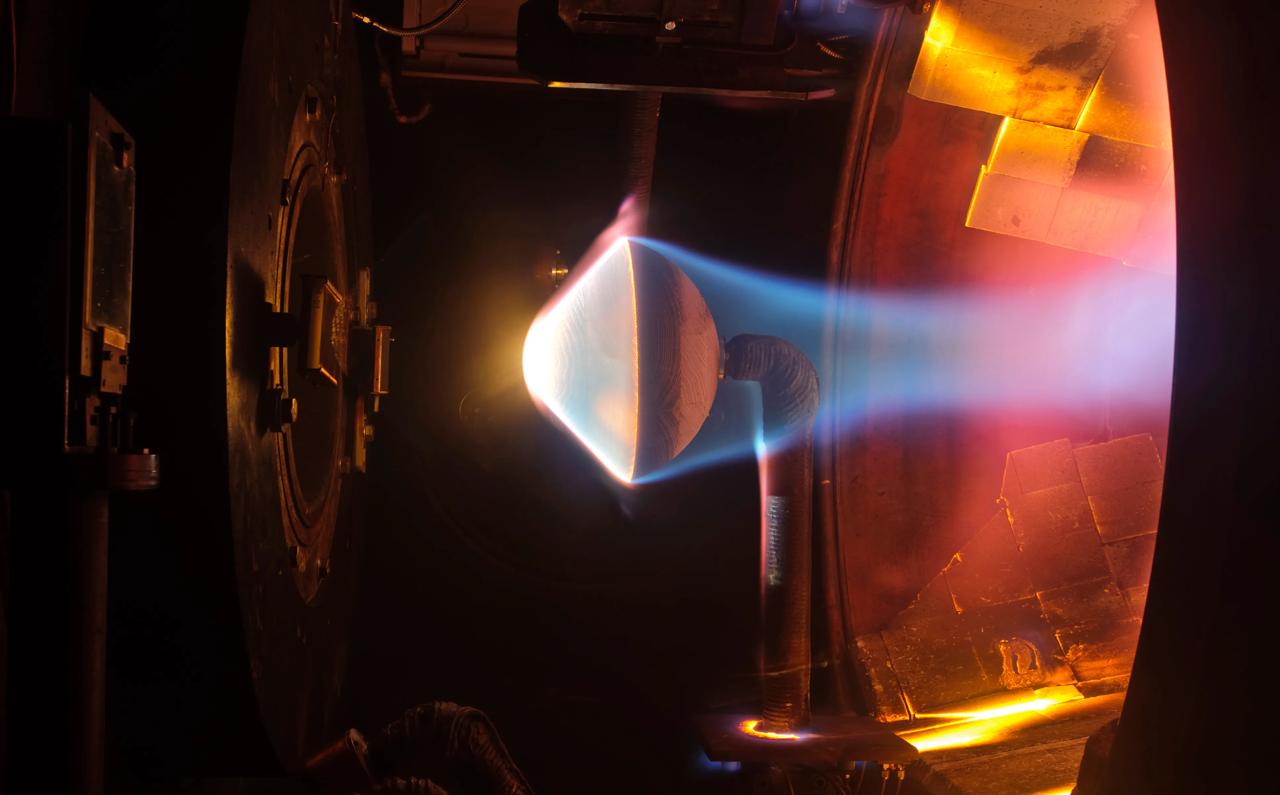
NASA Ames Arc-Jet Facility Opens to SpaceX and Blue Origin After Three-Year Buildout
A 30-kW arc-jet facility at NASA Ames Research Center has reached operational status and is now hosting external customers including SpaceX and Blue Origin. The facility, known as mARC II, was brought online under the leadership of NASA Postdoctoral Research Fellow Jocelino Rodrigues, who characterized the rig and expanded its testing capabilities over roughly three years. Rodrigues, a 20 Twenties award recipient and the program's first honoree from Portugal, joined NASA Ames to develop and cha
OST Staff · October 14, 2026
A 30-kW arc-jet facility at NASA Ames Research Center has reached operational status and is now hosting external customers including SpaceX and Blue Origin. The facility, known as mARC II, was brought online under the leadership of NASA Postdoctoral Research Fellow Jocelino Rodrigues, who characterized the rig and expanded its testing capabilities over roughly three years.
Rodrigues, a 20 Twenties award recipient and the program's first honoree from Portugal, joined NASA Ames to develop and characterize the facility so that the agency could understand what it can and cannot do. His role grew to include project management, instrumentation, data-acquisition system development, imaging, spectroscopy and new methods for measuring plasma flows.
Arc-jets function as a type of wind tunnel that produces extremely high-speed, high-temperature flows, sometimes reaching temperatures on the order of 10,000K, or 17,500F, turning the gas into plasma. Rodrigues said a large team contributed to bringing mARC II online, making it especially rewarding to see external customers able to test in the facility. He noted the facility gives Ames a new capability for relatively low-cost, high-throughput sample screening that had not previously been available.
In parallel with the facility work, Rodrigues developed a new method for estimating a critical parameter in arc-jet facilities. That work now forms the basis of a draft ASTM International standard, something he said he never imagined being involved in at this stage of his career.
Rodrigues has also focused on mentorship. Over the past year he volunteered with the University of Bristol Alumni Mentoring Programme, mentoring an undergraduate aerospace engineering student for a year, and he has mentored interns at NASA Ames during the summer. He has taken part in STEM outreach, including representing NASA's Entry Systems division at the Open Sauce Technology and Creator Festival and joining a virtual space Q&A with a high-school class.
Rodrigues framed the facility's progress in terms of broader success rather than individual output. He said his definition of success has expanded to include the team, branch, division, center and agency, as well as enabling others to grow. Supporting someone through their first conference paper as first author, or creating an opportunity for someone to test new technology when he was in a position as principal investigator to make that possible, were both experiences he described as genuinely rewarding. He said curiosity, from aerothermodynamics to plasma physics, keeps him engaged on challenging days, along with colleagues who share the same drive.
Nominations for the 2027 20 Twenties awards are open through Aviation Week's 20 Twenties Program.